WhatsApp Business API pricing in 2026: Meta's rates, provider fees and monthly costs
Editorial team · updated · facts checked
WhatsApp Business API pricing has two layers. Meta charges for each delivered message, by category and by the recipient's country code: on its card effective 1 July 2026, a utility template costs $0.0034 to a US number, $0.0068 in Brazil and $0.0085 in Mexico. Your provider then adds a per-message fee, a monthly licence or a bundled price.
We read Meta's rate files for 1 July and 1 October 2026 and every provider page cited here on 23 September 2026. Nobody on the editorial team sent messages; the monthly totals below are arithmetic on published prices. Access, templates and the 24-hour window are covered in our WhatsApp Business API guide.
How Meta prices WhatsApp messages
Meta has charged per delivered message since 1 July 2025, and its pricing page now lists conversation-based pricing as deprecated. Two things set the price: the message category (marketing, utility, authentication and, from 1 October 2026, service) and the country calling code of the number it goes to. Authentication-international rates, which depend on where the business is based, don't apply in the three markets below. A message that fails to deliver costs nothing at Meta, and messages users send you are never charged.
Four details trip up budgets:
- US and Canadian numbers share one rate, "North America". Not every +1 number does: Meta maps the Puerto Rico, Dominican Republic and Jamaica area codes to Rest of Latin America.
- Meta changes rates only on 1 January, 1 April, 1 July or 1 October, with at least one month's notice for a new rate card.
- Meta publishes the rates as CSV and PDF files, one set per billing currency (16 currencies), plus a lookup on business.whatsapp.com. The developer pages explain the rules; the files carry the numbers.
- Marketing costs the same through the Cloud API and the Marketing Messages Lite API, per the header of Meta's own CSV.
Meta's rates by category: US, Brazil and Mexico
The table uses Meta's USD rates CSV effective 1 July 2026, first volume tier, per delivered message. We also read the October 2026 files Meta published on 1 September: they add service rates, and the only rate that moves among these cells is Mexico's marketing rate.
| Category | United States (+1, North America) | Brazil (+55) | Mexico (+52) |
|---|---|---|---|
| Marketing template | Not delivered to US numbers (card lists $0.0250) | $0.0625 | $0.0305; $0.0397 from 1 October 2026 |
| Utility template | $0.0034 | $0.0068 | $0.0085 |
| Authentication template | $0.0034 | $0.0068 | $0.0085 |
| Service message (free-form reply inside the 24-hour window) | Free until 30 September 2026, then $0.0034 after 1,000 free per number a month | Free, then $0.0068 | Free, then $0.0085 |
WhatsApp "does not currently deliver marketing template messages" to US numbers, and a send attempt returns an error (Meta). The $0.0250 on the card still applies to Canadian numbers, which share the North America rate. Mexico's marketing increase is about 30 %. Authentication-international rates show as n/a for all three markets.
Meta also prints cards in local currency. On the July BRL card, Brazil utility is R$0.0350 and marketing R$0.3217. On the MXN card, Mexico utility is MX$0.1565 and marketing moves from MX$0.5614 to MX$0.7298 on 1 October. Which card applies depends on the currency of your WhatsApp Business Account (WABA).
Volume tiers: when the per-message rate drops
Only utility and authentication messages earn volume tiers. Meta counts charged messages per business portfolio, across all its WABAs, separately for each market and category, and resets the count each month at midnight in the WABA's timezone. Messages past a threshold get the next tier's rate; in these three markets the steps run from 5 % to 25 % off.
| Market | List rate (utility) | List rate applies up to, per month (utility / authentication) | Lowest utility rate |
|---|---|---|---|
| North America | $0.0034 | 80,000 / 100,000 | $0.0026 above 6,000,000 |
| Brazil | $0.0068 | 250,000 / 500,000 | $0.0051 above 70,000,000 |
| Mexico | $0.0085 | 1,000,000 / 250,000 | $0.0064 above 40,000,000 |
The October files keep these thresholds. At 1,000 or 10,000 messages a month you pay the list rate in all three markets. Even 100,000 utility templates to US numbers save only $4: 80,000 × $0.0034 + 20,000 × $0.0032 = $336.00 instead of $340.00. Check thresholds against Meta's file, not a provider's copy: Telnyx's Meta rate CSV ends Brazil's authentication list rate at 100,000 messages, Meta's July card at 500,000.
Because Meta counts per portfolio, splitting traffic across two providers doesn't reset the count; Meta's own example bills the second provider at the tier the business already reached. Providers don't always mirror that. Vonage says its billing replicates tiers per WABA, "rather than aggregating usage across your entire business", so customers with several providers may see different figures in WhatsApp Business Manager (Vonage). Vonage also limits tier discounts to Meta's fee; AWS applies Meta's tiers to the Meta fee and prints its own fee flat.
How providers add their fees
Every provider in our dataset that publishes a WhatsApp price uses one of three models. The first two keep Meta's fee as its own line; the third folds it into the provider's price.
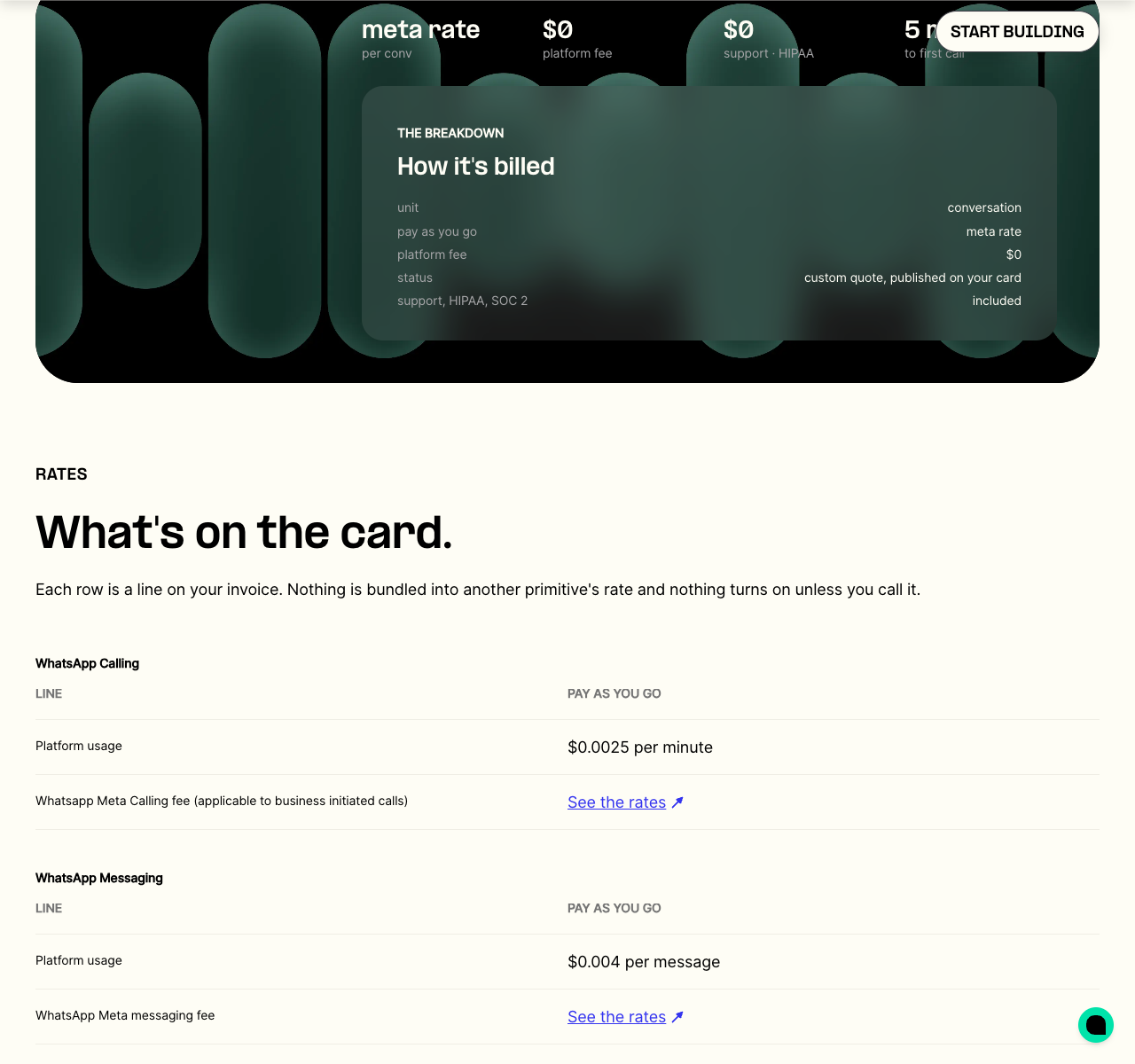
A per-message fee on top of Meta's rate. Twilio charges $0.005 per message, "inbound or outbound", plus $0.001 for each message that ends as failed. AWS End User Messaging charges $0.005 per outbound and $0.001 per inbound message. Vonage charges $0.00219 per delivered outbound utility message in North America and Brazil, $0.00278 in Mexico, and nothing for inbound. Gupshup charges $0.001 per message. Telnyx lists "Platform usage $0.004 per message" on the same page whose headline says "$0 markup":
A monthly licence per phone number. 360dialog charges $59 (€49) per number a month on its Regular tier and passes Meta's fee through with "no markup on Meta fees" (product page). Paying the licence by card adds a 4 % processing fee, which the totals below leave out. At one number, the licence equals Twilio's or AWS's per-message fee at 11,800 messages a month and Vonage's at about 26,900.
A bundled price. Plivo, WATI, Zenvia and Blip print one price per message (or per send) and list no separate Meta fee. Plivo's Brazil utility price is $0.0075, $0.0007 above Meta's list rate; Plivo doesn't say how the price divides. Bundled prices change when the provider republishes them, not when Meta does: WATI's rate cards (updated 1 July 2026) describe service and in-window utility messages as free, which holds only until 30 September.
Two surcharges only hit marketing traffic. 360dialog says marketing sent through /messages instead of the Marketing Messages API "results in a 7% increase over Meta's standard rates"; Gupshup's table adds a "Markup over non-MM Lite marketing messages" worth 6 % of Meta's marketing fee. And the Meta fee itself isn't identical everywhere: AWS bills it from Meta's INR card, converted at the INR–USD rate of 1 July 2026 and reviewable each quarter, so its Brazil utility charge is $0.0052 against $0.0068 on Meta's USD card. AWS's own sources differ slightly: its Price List API, published 16 September 2026, shows $0.0054 for Brazil and $0.0027 for the US. The totals below use the CSV on the pricing page; with the API figures, 10,000 Brazilian messages cost $104.00 instead of $102.00.
What 1,000 and 10,000 utility messages cost a month
Scenario: utility templates sent outside a customer service window, one business phone number, first volume tier, no replies and no failures, before tax. Meta doesn't change these rates on 1 October, so the totals hold on both cards. Where the provider passes Meta's fee through, it's included in the total.
One limit comes before cost. A new business portfolio can reach 250 unique users outside a service window in a moving 24 hours (Meta's messaging limits). 10,000 templates a month to different people average about 330 a day, so raise the limit first; WhatsApp business verification is one of Meta's three routes to 2,000.
| Provider (Meta's fee on top) | Provider's own charge | US, 1,000 | US, 10,000 | Brazil, 1,000 | Brazil, 10,000 |
|---|---|---|---|---|---|
| Meta direct (Cloud API) | None | $3.40 | $34.00 | $6.80 | $68.00 |
| 360dialog | $59 per number a month | $62.40 | $93.00 | $65.80 | $127.00 |
| AWS End User Messaging | $0.005 per message; Meta's fee from the INR card ($0.0026 US, $0.0052 Brazil) | $7.60 | $76.00 | $10.20 | $102.00 |
| Gupshup | $0.001 per message | $4.40 | $44.00 | $7.80 | $78.00 |
| Telnyx | $0.004 per message | $7.40 | $74.00 | $10.80 | $108.00 |
| Twilio | $0.005 per message | $8.40 | $84.00 | $11.80 | $118.00 |
| Vonage | $0.00219 per message | $5.59 | $55.90 | $8.99 | $89.90 |
The next table is not directly comparable: Meta's share is bundled, and two of the plans are priced in reais.
| Provider (bundled) | How it prices | US, 1,000 | US, 10,000 | Brazil, 1,000 | Brazil, 10,000 |
|---|---|---|---|---|---|
| Blip | Blip Go Essencial: R$389 a month with 100 sends, then R$0.69 per send; runs on a WhatsApp Business app number through Meta's Coexistence | No US price | No US price | R$1,010.00 | R$7,220.00 |
| Plivo | $0.0037 (US) and $0.0075 (Brazil) per utility message; USD 1,000 monthly minimum across Plivo products | $3.70 of usage, billed at least $1,000 | $37.00 of usage, billed at least $1,000 | $7.50 of usage, billed at least $1,000 | $75.00 of usage, billed at least $1,000 |
| Sinch | No public WhatsApp price | Not published | Not published | Not published | Not published |
| WATI | Growth plan plus message credits: $69 a month and $0.00612 per utility message (US); R$369 a month and US$0.00918 (Brazil) | $75.12 | $130.20 | R$369 + US$9.18 | R$369 + US$91.80 |
| Zenvia | Monthly channel packages, one price for every template category, R$649 setup in the first month | No US price | No US price | R$1,000 package (R$0.49 each, up to 2,041) | Above the largest published package (R$2,000 for 4,256): price on request |
Blip's English page (modified 22 July 2026) still shows R$299 a month and R$0.60 per extra send; the totals use the Portuguese page, modified 8 September. Zenvia's packages are shared by all its channels, and one for more than 4,256 templates is quoted by sales.
At 1,000 messages the provider's cut is a few dollars, but it can be most of the bill: Twilio's fee makes a US batch about 2.5 times Meta's direct price, and 360dialog's licence about 18 times. Going direct to Meta removes that layer, but you then run the token, webhook and template work yourself; the WhatsApp Cloud API tutorial walks through that route step by step, and Evolution API vs WhatsApp Cloud API sets Meta's Brazil rates against self-hosting. At 10,000 Brazilian messages the per-message models land between $78 and $118 and the licence at $127. Replies change the picture: Twilio charges its $0.005 on each inbound message, AWS and Gupshup $0.001, while Vonage charges nothing inbound. WATI's Growth plan lists 10,000 API calls a month and "No Webhooks", which matters if your app sends through the API. Read it this way: under about 12,000 messages per number a month, every per-message provider costs less than the licence. WATI, Blip and Zenvia build software (inbox, campaigns, automation) into the plan, so they fit teams that want those tools, not only an API; Plivo's minimum counts spend across all its products. Country-level shortlists are in the rankings for the US, Brazil and Mexico.
What changes on 1 October 2026
Three charges start that day, per Meta's pricing page (updated 10 September 2026) and its non-template pricing page:
- Service messages. Free-form replies inside the 24-hour window cost the market's utility rate. Each business phone number gets 1,000 free delivered service messages a month, with no roll-over; a group send uses one per recipient. Service messages get no volume tiers.
- Utility templates inside an open window. Free since 1 July 2025, charged again at the utility rate.
- Mexico marketing rises from $0.0305 to $0.0397.
Add a payment method before then. The pricing page says a WABA without one gets service messages delivered only within the free tier; the non-template page, last updated 25 August 2026, says Meta will stop delivering them to anyone without a payment method on file by 30 September.
A worked example: a support bot on one number, your own or one built on a third-party AI model (both count as service messages), answers 5,000 messages a month in Brazil. Until 30 September, Meta charges nothing for those replies. From 1 October: (5,000 − 1,000) × $0.0068 = $27.20 a month. Spread over two numbers, each with its own 1,000, it drops to 3,000 × $0.0068 = $20.40. At US rates it's $13.60, at Mexican rates $34.00. Provider fees don't change: at Twilio those 5,000 replies already cost $25.00 before October.
Meta Business Agent, Meta's own AI agent, has been billed since 1 August 2026 at $2.00 per million tokens, which Meta puts at "approximately 4–5 cents" a message. That is roughly six to seven times a Brazilian utility template.
Some provider pages still describe the current rules, which end on 30 September. Twilio's pricing summary, marked current as of August 2026, says "No Meta fee during customer service window". WATI's help center already covers October but gives the free allowance "for each WhatsApp Business Account", while Meta's page grants it per business phone number. Vonage lists service messages at its utility fee from 1 October.
How to check what Meta charged
Status webhooks carry a pricing object with billable, category and type (Meta). From 1 October a service reply inside the free tier arrives as "type": "free_customer_service" with "billable": false; once the number's 1,000 are used, the same reply shows "type": "regular" and "billable": true. Log those fields per phone number and you can reconcile the invoice yourself. Tier changes arrive as an account_update webhook with the event VOLUME_BASED_PRICING_TIER_UPDATE.
What is still free
Three things cost nothing at Meta: messages users send you; everything in a 72-hour free entry point window, which opens when you reply within 24 hours to someone who wrote from a Click to WhatsApp ad or a Facebook Page button (Meta Business Agent messages excepted); and, from 1 October, the first 1,000 service messages per number each month. Provider fees are separate: a message Meta doesn't charge for can still carry Twilio's or Gupshup's fee.
Related guides
- WhatsApp Business API guide: access, verification, templates, webhooks and Brazil's BRL billing deadline
- WhatsApp Cloud API tutorial: the direct route with no provider fee, from Meta app to first template send
- WhatsApp business verification steps: documents, Security Center steps and the messaging limits that gate volume
- WhatsApp vs SMS, email and voice for one-time codes: authentication-template costs next to SMS
- Payment reminder templates for SMS, WhatsApp and email: what a payment reminder costs per channel
- Text to pay by WhatsApp, SMS and email: sending a payment link in a message
- Best WhatsApp API providers, ranked
- All provider cards, each fact with its source and check date
About this guide
The PingMyUsers editorial team wrote this article under the rules on the methodology page; the directory is operated by Sensaria AG in Switzerland. We did not create accounts or send messages. Providers appear alphabetically; none paid for placement or reviewed the text. Report an error to contact@sensaria.ch; corrections are dated and sourced.
Methodology
On 23 September 2026 we downloaded Meta's USD, BRL, MXN and INR rate CSVs effective 1 July 2026 and the USD, BRL and MXN files for 1 October 2026 from Meta's pricing page, and read the rates and volume tiers for North America, Brazil and Mexico as printed. For AWS we also read its Price List API. Provider prices come from the directory's dataset and were re-read that day on each provider's page or rate file; Blip, Zenvia and WATI prices are in the currency the provider prints. Monthly totals are our arithmetic on those numbers, with no currency conversion.
Last updated
23 September 2026: first version. Meta moves the October cards into "current" on 1 October 2026; we re-check the rates and provider pages then, and every six months after.
Frequently asked questions
How much does the WhatsApp Business API cost per message?
On Meta's card effective 1 July 2026, utility and authentication templates cost $0.0034 to US numbers, $0.0068 in Brazil and $0.0085 in Mexico. Marketing costs $0.0625 in Brazil and $0.0305 in Mexico ($0.0397 from 1 October 2026) and isn't delivered to US numbers. Provider fees come on top.
Is the WhatsApp Business API free?
No. Meta doesn't charge for messages users send you, messages in a 72-hour free entry point window or, from 1 October 2026, the first 1,000 service messages per number each month. Everything else is billed per delivered message, plus provider fees.
Is WhatsApp API pricing per conversation or per message?
Per message, since 1 July 2025. Meta charges for each delivered template and, from 1 October 2026, for service messages.
Are WhatsApp service messages charged after October 2026?
Yes. From 1 October 2026 each business phone number gets 1,000 free service messages a month; after that each costs the market's utility rate, with no volume tiers.
Why does the same WhatsApp message cost more at some providers?
Providers add a per-message fee, a monthly licence per number or a bundled price. AWS also bills Meta's fee from Meta's INR card, so even that part differs.
How do WhatsApp volume tiers work?
Utility and authentication messages get lower rates past monthly thresholds, counted per business portfolio, market and category. In the US the list rate applies to the first 80,000 utility messages a month.
Can I send WhatsApp marketing messages to US numbers?
No. WhatsApp doesn't currently deliver marketing templates to US phone numbers; utility and authentication templates are delivered.
Sources
- Meta — Pricing on the WhatsApp Business Platform (updated 10 September 2026) — checked 23 September 2026
- Meta — Rate cards and volume tiers effective 1 July 2026 (USD, BRL, MXN, INR CSV files) — checked 23 September 2026
- Meta — Rate cards effective 1 October 2026 (USD, BRL, MXN files published 1 September 2026) — checked 23 September 2026
- Meta — Volume tiers: tiering accrual and key dynamics — checked 23 September 2026
- Meta — Upcoming pricing updates for Meta Business Agent, service and utility messages (updated 25 August 2026) — checked 23 September 2026
- Meta — Per-user marketing template message limits (US delivery) — checked 23 September 2026
- Meta — Messaging limits (250 unique users per moving 24 hours for new portfolios) — checked 23 September 2026
- WhatsApp Business — Business Platform pricing — checked 23 September 2026
- 360dialog — Pricing (client documentation) — checked 23 September 2026
- 360dialog — WhatsApp API product page ("no markup on Meta fees") — checked 23 September 2026
- 360dialog — Payments (4% processing fee on licence invoices) — checked 23 September 2026
- AWS End User Messaging — pricing (WhatsApp fees) — checked 23 September 2026
- AWS — WhatsApp Meta fee CSV (effective July 2026) — checked 23 September 2026
- AWS Price List API — WhatsApp Meta fees (published 16 September 2026) — checked 23 September 2026
- Blip — Blip Go plans (Portuguese) — checked 23 September 2026
- Blip — Blip Go (English page, modified 22 July 2026) — checked 23 September 2026
- Gupshup — WhatsApp API self-serve pricing — checked 23 September 2026
- Plivo — WhatsApp pricing (United States) — checked 23 September 2026
- Plivo — WhatsApp pricing (Brazil) — checked 23 September 2026
- Plivo — WhatsApp prerequisites (minimum monthly commitment) — checked 23 September 2026
- Sinch — WhatsApp Business API product page — checked 23 September 2026
- Telnyx — WhatsApp pricing — checked 23 September 2026
- Telnyx — Meta pass-through rates (CSV) — checked 23 September 2026
- Twilio — WhatsApp pricing — checked 23 September 2026
- Twilio — WhatsApp pricing details (CSV) — checked 23 September 2026
- Vonage — WhatsApp Pricing: Vonage Platform Fees (updated 10 September 2026) — checked 23 September 2026
- Vonage — WhatsApp Pricing (volume tiers, inbound messages) — checked 23 September 2026
- WATI — Pricing — checked 23 September 2026
- WATI — Rate card, USD, Growth/Pro (updated 1 July 2026) — checked 23 September 2026
- WATI — Rate card, LATAM, Growth/Pro (updated 1 July 2026) — checked 23 September 2026
- WATI — Understanding WATI's pricing structure — checked 23 September 2026
- Zenvia — Preços (Brazil) — checked 23 September 2026