A2P 10DLC registration: how to register your brand and campaign (2026)
Editorial team · updated · facts checked
A2P 10DLC registration is the process US carriers require before an app texts people from an ordinary 10-digit local number. Through your SMS provider you register a brand (your company, checked against its tax ID) and a campaign (what you send and how people opt in), then attach numbers. Most providers charge $4.50 per brand and $15 per campaign review.
We checked every page cited here on 23 September 2026: The Campaign Registry, CTIA, and six SMS providers' 10DLC docs and fee pages. We did not register a brand or send messages, so timelines are the providers' published estimates.
What is A2P 10DLC registration?
A2P (application-to-person) covers any text an application sends to a person; 10DLC (10-digit long code) is a standard local US number. Twilio says US carriers treat everything sent through a messaging provider as A2P, and its A2P 10DLC overview describes 10DLC registration as the standard carriers put in place so that long-code traffic is "verified and consensual".
Registration creates two records: the brand (who sends: legal name, tax ID, address, website) and the campaign (what you send and how recipients agreed to it). Numbers are then linked to an approved campaign.
Five parties touch a registration:
| Party | Role |
|---|---|
| Brand | Your business, or you as a sole proprietor |
| CSP (Campaign Service Provider) | Your SMS provider; submits your data |
| The Campaign Registry (TCR) | Industry registry of brands and campaigns |
| Vetting provider | Scores the brand's identity (Telnyx's example uses Aegis Mobile) |
| Carriers (T-Mobile, AT&T, Verizon) | Set throughput and fees; approve special use cases |
TCR's own site corrects two common assumptions. Brands cannot register with TCR directly: its home page sends them to a registered CSP. And its FAQ says TCR "does not review, approve, or reject campaigns"; the CSP and its upstream partners do. "Rejected by TCR" in provider docs is shorthand for that chain.
Is it a law? AWS calls TCR "an industry organization" and Twilio's overview calls 10DLC a carrier standard; none of the pages we checked describes a filing with the FCC. Twilio's quickstart still says "US regulations require" it. Consent law runs separately: CTIA's Messaging Principles and Best Practices tell senders to follow the TCPA and FCC consent rules either way. This guide summarizes industry and provider rules; it is not legal advice.
Who needs 10DLC registration, and who can skip it
Anyone sending app-generated SMS or MMS to US numbers from a 10DLC number; Twilio adds that this "includes individuals and hobbyists". Unregistered traffic does not go out: Twilio blocks it with error 30034 (its overview still speaks of extra carrier fees), Plivo does not deliver messages from unlinked long codes, and AWS says unregistered US long codes cannot send SMS. For sending code, see our tutorial on sending SMS from Node.js and Python.
You do not need 10DLC registration when:
- you send from a toll-free number (it has its own toll-free verification process) or a short code;
- you only send sign-in codes through a verification product on the provider's registered senders: numbers used only for Twilio Verify are exempt, and Plivo's Verify sends on Plivo-registered sender IDs (see our OTP and verification API rankings);
- you are still testing: Twilio's Virtual Phone and AWS's simulator numbers never reach a carrier. Twilio trial accounts cannot register at all.
A2P 10DLC registration requirements checklist
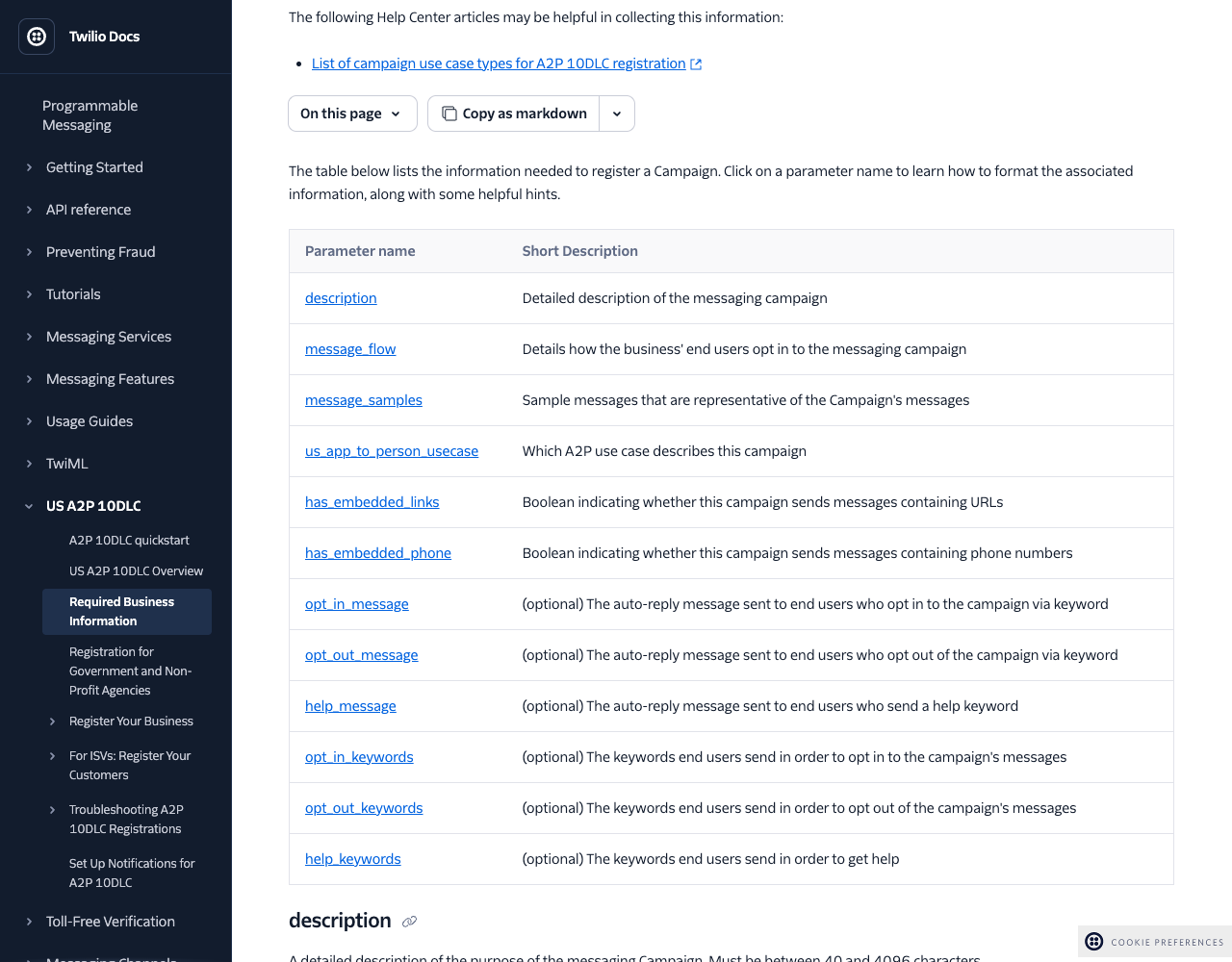
Field names differ by provider, but the data feeds the same TCR records; the lists follow Twilio's required business information page, the most detailed we found.
Brand (company) information
- Legal name exactly as on the IRS EIN letter (CP 575) or a 147C letter, not the W-9 spelling. New EINs can take 30 to 90 days to reach validation databases.
- EIN (or a foreign tax ID) and the address used for the IRS registration, as TCR's FAQ asks.
- Business type, industry, regions, public or private status, stock ticker if public.
- A working website related to the name. TCR rejects URLs that fail to load, sit on a parked or for-sale domain, require a login, or redirect to an unrelated domain.
- An authorized representative: name, exact title, position, phone, email.
- Public for-profit companies: a contact email on the company's domain for the Authentication+ check; free addresses and distribution lists fail.
- Each email and street address can back at most 10 brands across all providers.
Sole proprietors (US or Canada, no EIN) give a name, email, address and a mobile number for a one-time passcode; that number cannot come from a CPaaS provider and may back at most three brands. A sole proprietorship with an EIN registers as a Low-Volume Standard or Standard brand.
Campaign information
- Use case, such as 2FA, account notification, customer care, marketing, mixed or Low Volume Mixed.
- Description, 40 to 4,096 characters: who sends, who receives, why.
- Message flow (how people opt in), 40 to 2,049 characters, linking the opt-in page, privacy policy and terms.
- Two to five samples, 20 to 1,024 characters each, naming the brand, with [brackets] for variables.
- Flags for embedded links, phone numbers, direct lending and age-gated content.
- Keyword replies for opt-in, opt-out and help (20 to 320 characters) if you replace the provider's defaults.
10DLC registration step by step
Every provider we checked follows this order; names and waiting times differ.
- Choose 10DLC and a provider. Toll-free numbers and short codes are the alternatives; the provider acts as your CSP throughout. At Twilio, upgrade from trial first.
- Create the business profile. Twilio's Primary Customer Profile "may take 72 hours or more" to approve, but later steps can start meanwhile. Plivo calls it a Profile; AWS starts with company registration.
- Register the brand. The provider submits it to TCR for an identity check. At Twilio this takes minutes, or seven business days or more if the brand goes to manual review (
IN_REVIEW). Twilio charges the brand fee at creation, even if the brand ends up unverified. - Vet the brand for more throughput. A vetting provider assigns a Trust Score (0 to 100, per Telnyx). AWS says to vet before creating campaigns because scores are not applied to existing ones; Telnyx lets campaigns go first, with limited throughput until scored.
- Register the campaign. People review it by hand, and special use cases also need carrier approval. This is the slow step.
- Link numbers. Twilio registers the numbers on the campaign's Messaging Service after approval, "not instant". AWS allows each number on one campaign only, and TCR's FAQ says more numbers do not add throughput: the brand and campaign set it.
Sole Proprietor, Low-Volume Standard or Standard brand
Twilio's overview and fee article define three brand types (checked 23 September 2026):
| Sole Proprietor | Low-Volume Standard | Standard | |
|---|---|---|---|
| Who | US or Canadian individual without an EIN | Business with a tax ID, under about 6,000 segments a day | Business with a tax ID, above 6,000 a day |
| Campaigns per brand | 1, with 1 phone number | Up to 5 | Up to 5 |
| Daily limit to T-Mobile | 1,000 segments (about 3,000 across carriers) | Up to 2,000 (about 6,000); Russell 3000 companies 200,000 | From 2,000 to unlimited, by Trust Score |
| Brand fee at Twilio | $4.50 | $4.50, no secondary vetting | $46, includes secondary vetting |
| Campaign type and monthly fee | Sole Proprietor, $2 | Low Volume Mixed, $1.50 | Standard use cases, $10; special use cases vary |
Limits vary by provider: Plivo's 10DLC page allows standard brands 3 campaigns and 49 numbers per campaign. Carriers meter differently too: per AWS, AT&T sets a per-second rate per campaign, T-Mobile a daily cap, and Verizon no published limit, relying on filtering.
Campaign approval requirements: privacy policy, opt-in and consent
Twilio's campaign onboarding guide calls the message flow the place "where most rejections happen": reviewers check that the call-to-action and disclosures appeared where the phone number was collected.
A web form that passes, per Twilio's guide, has:
- a phone number field and a consent checkbox that is not pre-selected;
- a description of the messages, their frequency, and "Msg & data rates may apply";
- HELP and STOP instructions and links to the terms and privacy policy;
- separate checkboxes for marketing and for transactional texts, and neither combined with the box that accepts the terms or privacy policy.
A form that is not live yet, or sits behind a login, can be shown through a public link to screenshots or a video.
Privacy policy: public, no login, naming the registered brand, stating that mobile numbers and SMS opt-in data are not shared with third parties or affiliates for marketing, and disclosing frequency and "Message and data rates may apply". TCR rejects login-gated policies and those missing the non-sharing statement.
Terms: public, on the brand's own domain, with program name and description, rates and frequency, support contact, HELP and STOP instructions, a privacy-policy link, and a line that carriers are not liable for delayed or undelivered messages.
CTIA's principles supply the consent levels behind these rules. Replying to a text the person started needs no further permission; reminders and alerts need express consent; promotions need express written consent, such as a box the person ticks. Recurring programs confirm each opt-in, confirm each opt-out once, and keep records: timestamp, method, wording shown, campaign, IP address and number.
Illustrative code, written from the official documentation and not run by the editorial team.
Web form, next to an unchecked checkbox:
[ ] Text me appointment reminders and account alerts from Acme Bookings.
    Up to 6 msgs/month. Msg & data rates may apply. Reply HELP for help,
    STOP to cancel. Terms: acme.example/sms-terms  Privacy: acme.example/privacy

Opt-in confirmation (first message after consent):
Acme Bookings: you're signed up for reminders and account alerts.
Up to 6 msgs/month. Msg & data rates may apply. Reply HELP for help, STOP to cancel.
Why 10DLC campaigns get rejected
The table uses Twilio's documented error codes and fixes from its troubleshooting page and onboarding guide. Other providers word the same causes differently; Telnyx names vague samples, missing opt-out language and use-case mismatch.
| Rejection or symptom | Documented cause | Fix |
|---|---|---|
Brand FAILED, tax ID mismatch | Name differs from the CP 575, or a new EIN has not propagated | Exact legal name; wait, or appeal with the CP 575 or 147C (Twilio: 5 to 7 business days) |
| Brand fails on email | Free or distribution address for Authentication+ | Address on the company's domain |
| Website rejected | Down, parked, for sale, login-gated or redirecting | Live site on the brand's domain |
| 30886: invalid campaign description | Vague ("Marketing") or not matching the brand | Who sends, to whom, why |
| 30893: invalid sample message content | Samples missing, unclear or off the use case | Real templates naming the brand |
| 30892: URL shortener in sample | bit.ly or TinyURL links | A branded short domain you own |
| Message-flow rejection | Pre-checked box, opt-in requested by unsolicited text, policy without the non-sharing line | Fix the form and policy (checklist above) |
| ISV registered instead of its customer | A platform registered itself for a client's texts | Register the business that sends |
| 30883 content violation (SHAFT), 30884 spam or phishing risk, 30885 fraud risk | Prohibited content or use case | Not fixable by editing; change the campaign or appeal |
| Campaigns rejected under a busy EIN | Twilio: a sixth brand on one tax ID needs a business reason; past 50 brands are invalid | One brand, several campaigns |
Two cost traps: Twilio bills the $15 vetting fee once per campaign, so edit and resubmit a failed one instead of deleting it, since a recreated campaign is billed again. Telnyx bills $15 per review, and its vetting team may resubmit a campaign several times unless told not to.
How long 10DLC registration takes
Estimates differ by provider, and Twilio's pages disagree with each other (checked 23 September 2026):
| Step | AWS End User Messaging (US company) | Twilio | Telnyx |
|---|---|---|---|
| Business profile | Part of company registration | 72 hours or more; later steps can start | Not a separate step |
| Brand | 1–2 business days (non-US companies: up to 3 weeks) | Minutes; 7+ business days in manual review | Instant |
| Vetting | 1–2 business days (non-US: up to 3 weeks) | Included in the $46 Standard brand | 1–7 business days; enhanced longer |
| Campaign | Up to 4 weeks | 10–15 days (current notice); 2–3 weeks (approval section); "several days" (quickstart) | Instant, pending carrier approval |
| Numbers | Up to 10 days in the table; about 14 days in the text | After approval, not instant | Instant |
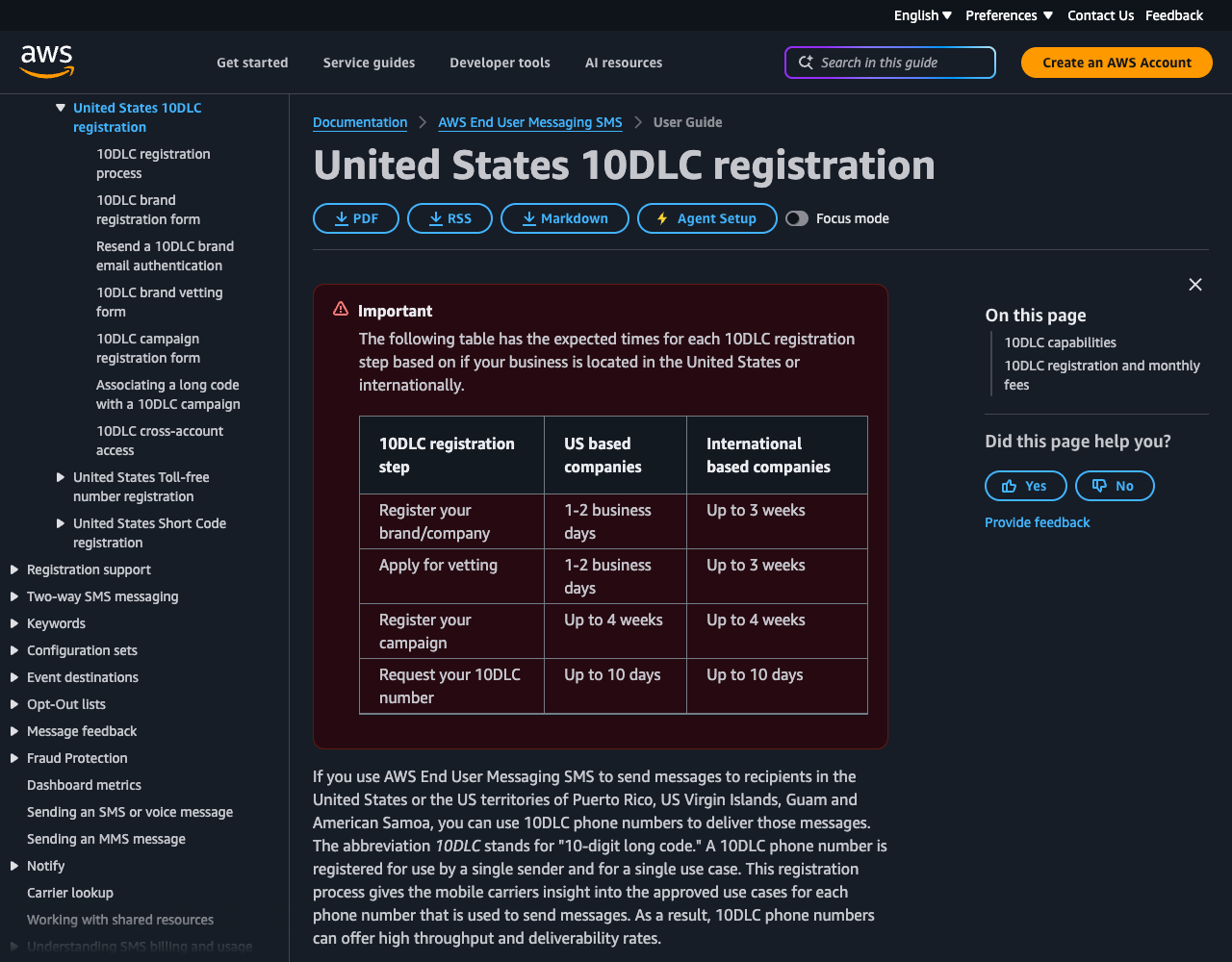
Twilio attributes its 10–15-day estimate to "an increase in campaign submissions". Count back about four weeks from launch and build against a test number meanwhile. Sole proprietors must also answer the passcode text within 24 hours, or trigger it again.
10DLC registration cost: fees by provider
TCR raised its fees on 1 August 2025, per Twilio's fee article: brand registration $4.00 to $4.50, standard vetting $40.00 to $41.50, appeals $10.00 to $11.00, and Authentication+ from free to $12.50 per retry. Providers pass fees through ("with no added cost", Twilio; "at cost", Telnyx), so differences come from billing rules and what each lists.
| Provider | Brand registration | Brand vetting | Campaign review | Low-volume campaign, monthly | Standard campaign, monthly | Notes | Checked |
|---|---|---|---|---|---|---|---|
| AWS End User Messaging | $4.50; resubmission $4.50 | $41.50 | None listed | $2 | $10 | Authentication+ $12.50; T-Mobile's $50 activation fee postponed | 23 Sep 2026 |
| Plivo | $4.50 | $41.50, optional | $15 | $1.50, billed quarterly | $10 | SMS only on the Enterprise plan, from $1,000 a month | 23 Sep 2026 |
| Sinch | Not readable | Not readable | Not readable | Not readable | Not readable | Fee article behind a Cloudflare challenge; number $1 a month + $1 setup | 23 Sep 2026 |
| Telnyx | $4.50 (Sole Proprietor $4) | $41.50 | $15 per review | $1.50 | $10 | Campaign fees billed three months up front | 23 Sep 2026 |
| Twilio | $4.50; Standard brand $46 | In the $46 | $15 | $1.50 | $10 | Billed at approval, then monthly | 23 Sep 2026 |
| Vonage | 4.50 | 41.50; enhanced 101.50 | 15 | 1.50, 3-month minimum | 10 | Fees "in US Dollars or Euros" | 23 Sep 2026 |
Rows are alphabetical, USD unless marked; scores are in the US SMS API rankings. Full fee sets with sources, including special use cases such as Charity (Twilio $3, Vonage 5), are on the provider cards for AWS End User Messaging, Plivo, Sinch, Telnyx, Twilio and Vonage.
Registration is the small part of the bill. Carriers add a per-segment fee on top of the provider's rate: Twilio's US SMS pricing page lists T-Mobile at $0.0045 outbound and $0.0025 inbound, AT&T $0.0035 each way and Verizon $0.0045 outbound; AWS lists one $0.00421 fee for all networks. Where unregistered traffic still flows it costs more (Telnyx lists T-Mobile at $0.012 and AT&T at $0.01 per SMS), and T-Mobile passes through fines of $1,000 for 10DLC program evasion and $10,000 per content violation.
What changed in 10DLC registration in 2025 and 2026
- 17 October 2024: TCR's Authentication+ for public for-profit brands: a representative confirms a 2FA email within 7 days; the CSP can resend it for up to 30 days.
- 1 August 2025: the fee increase above, including $12.50 per Authentication+ retry.
- 7 August 2025: Auth+ 2.0 split Authentication+ from the identity check, so each is appealed separately and vetting can run in parallel.
- 30 June 2026: Twilio's API requires
PrivacyPolicyUrlandTermsAndConditionsUrlfor new campaigns (changelog, 6 April 2026); existing campaigns are unaffected. - 1 October 2026: Vonage says "non-compliance fees will apply to 10DLC messaging campaigns found to be in violation", passed through to customers (US SMS restrictions).
Worked scenario: a US SaaS app registers a Low Volume Mixed campaign
Assume a scheduling app run by a US LLC with an EIN. It texts appointment reminders, sign-in codes and account alerts, about 1,000 segments a day at peak, with no promotions. That fits a Low-Volume Standard brand and one Low Volume Mixed campaign (under 2,000 segments a day to T-Mobile). We follow Twilio's documented flow, the most detailed of the six.
1. Account and number. Upgrade from trial and buy a local number: $1.15 a month on Twilio's list prices.
2. Profile and brand. Legal name as printed on the CP 575, EIN, IRS address, live website. Low-Volume Standard costs $4.50 (in Twilio's API, skip_automatic_sec_vet is true); a private company skips Authentication+.
3. Campaign. Low Volume Mixed: $15 review, then $1.50 a month. The description names the app, the recipients (customers who booked) and the three message types; the message flow points to the signup form with the unchecked box shown earlier. Samples:
Illustrative code, written from the official documentation and not run by the editorial team.
Acme Bookings: reminder, your appointment with [provider] is on [date] at [time]. Reply C to confirm. STOP to opt out.
Acme Bookings: your sign-in code is [code]. It expires in 10 minutes.
Acme Bookings: the email on your account was changed on [date]. Not you? Visit acme.example/security. STOP to opt out.
4. Wait and test. Twilio currently quotes 10 to 15 days; plan three to four weeks, testing against the Virtual Phone.
5. Costs. Registration and number fees: $22.15 in the first month ($4.50 + $15 + $1.50 + $1.15), $51.30 in the first year ($19.50 once plus 12 × $2.65). Messages cost far more: 30,000 segments a month at Twilio's $0.0083 is $249, plus carrier fees of $0.0035 to $0.005 each. On AWS the same setup lists $4.50, then $2 a month for the campaign and $1 for the number, with no review fee: $40.50 a year ($4.50 plus 12 × $3). Plivo sells SMS only on its Enterprise plan, from $1,000 a month.
What would get it rejected: a "20% off your next visit" sample (promotions need express written consent on a separate checkbox and a marketing use case), a bit.ly link, a policy without the non-sharing line, or a login-gated form with no screenshots.
When to change it: past 2,000 segments a day to T-Mobile, move to a Standard brand ($46 with vetting) and $10-a-month campaigns, vetting first. Sending sign-in codes through Twilio Verify takes them out of 10DLC entirely.
Registering 10DLC through an API or an AI coding agent
Registration is scriptable at most providers: Telnyx documents POST /v2/10dlc/brand, a vetting call and a campaign builder; Plivo has Profile, Brand, Campaign and Number Linking APIs under /v1/Account/{auth_id}/10dlc/; Sinch, Vonage and AWS offer registration APIs too. Twilio sends direct brands through the Console and keeps its API for ISVs.
An agent can fill the fields from your docs but cannot produce the consent evidence reviewers want, and each submission can cost $15: have a person check form, policy and samples first. Provider cards list MCP servers and agent skills with sources, and our read-only API and MCP server serves the same data to agents.
Related guides
- SMS API rankings, scored with published weights
- Best SMS APIs for sending to the United States
- OTP and verification API rankings, for sign-in codes without 10DLC registration
- How to send a text message with an API in Node.js and Python
- What is an SMS gateway?: how a text travels from your API call to the carrier, and what it costs
- SMS sender ID rules by country: what replaces 10DLC in Brazil, Mexico and 20 other countries
- Toll-free texting verification: fields, review times and rejection fixes
- SMS, WhatsApp, email or voice for one-time codes: cost, security and fallback order
- Text to pay: payment links by SMS, incl. the 10DLC use case and link rules
- Transactional email guide: SPF, DKIM, DMARC and provider setup
- WhatsApp Business API guide: access, pricing and setup
- Browse every provider card in the catalog
About this guide
The PingMyUsers editorial team wrote this guide for developers adding SMS to a US app; Sensaria AG in Switzerland operates the directory. Providers do not pay for placement, and none reviewed this page. Fees and limits link to the provider's or registry's own page and match the data files behind our six provider cards. To report an error, email contact@sensaria.ch with the page and the source showing the correct fact.
Methodology
On 23 September 2026 we checked each source listed on this page: TCR's site and FAQ, CTIA's principles, and each provider's 10DLC docs and fee pages. Fees are as printed, USD unless marked; silent or unreadable pages are marked as such. We did not register brands or campaigns or send messages, so approval times are the providers' estimates. Two TCR PDFs returned no extractable text, so we quote TCR's HTML pages.
Section order follows 75 searches GPT and Gemini ran for 10 phrasings of the question. Our scoring method is on the methodology page.
Last updated
23 September 2026: first version, all facts checked that day. Next scheduled re-check: March 2027, or sooner if TCR or a provider changes fees or requirements.
Frequently asked questions
What is 10DLC registration?
Registering your business (brand) and messaging use case (campaign) with The Campaign Registry, through your SMS provider, before an app texts people from a standard 10-digit US number. Carriers use it to verify senders and consent.
Is A2P 10DLC registration required?
Yes, for any application texting US numbers from a 10DLC number, hobbyists included, per Twilio. Twilio blocks unregistered traffic (error 30034), and Plivo and AWS do not deliver it. Toll-free numbers and short codes have separate processes.
How much does 10DLC registration cost?
At most providers checked on 23 September 2026: $4.50 per brand, $15 per campaign review and $1.50 to $10 a month per campaign. Twilio's Standard brand costs $46 including vetting; AWS lists no review fee and charges $2 a month for a low-volume campaign.
How long does 10DLC registration take?
US brands take minutes to two business days unless sent to manual review. Campaigns are slow: up to 4 weeks at AWS, 10 to 15 days at Twilio under its current notice. Plan about four weeks.
Can I register directly with The Campaign Registry?
No. TCR's site says direct registration is not available for brands; you register through a Campaign Service Provider, which is normally your SMS provider.
Can a sole proprietor register for 10DLC?
Yes, in the US or Canada without an EIN. At Twilio a Sole Proprietor brand gets one campaign, one number and 1,000 segments a day to T-Mobile, verified by a passcode sent to a personal mobile.
Why was my 10DLC campaign rejected?
Usually the message flow: a pre-checked or missing consent box, a privacy policy without the non-sharing statement, or terms on another domain. Vague descriptions, unbranded samples and public URL shorteners follow. SHAFT content such as cannabis cannot be fixed by editing.
Do I need 10DLC registration to send OTP codes?
Not through a verification product on the provider's registered senders: numbers used only for Twilio Verify are exempt. Codes from your own 10DLC number need a campaign with the 2FA or a mixed use case.
Sources
- The Campaign Registry — home (brands register through a CSP) — checked 23 September 2026
- The Campaign Registry — Resources and FAQ — checked 23 September 2026
- The Campaign Registry — Authentication Plus is Here (25 October 2024) — checked 23 September 2026
- The Campaign Registry — Introducing Auth+ 2.0 (7 August 2025) — checked 23 September 2026
- CTIA — Messaging Principles and Best Practices (May 2023) — checked 23 September 2026
- Twilio — Programmable Messaging and A2P 10DLC — checked 23 September 2026
- Twilio — A2P 10DLC registration application quickstart — checked 23 September 2026
- Twilio — A2P 10DLC: Gather the Required Business Information — checked 23 September 2026
- Twilio — Direct Standard and Low-Volume Standard Registration Guide — checked 23 September 2026
- Twilio — Direct Sole Proprietor Registration Overview — checked 23 September 2026
- Twilio — Troubleshooting and rectifying Campaigns — checked 23 September 2026
- Twilio changelog — privacy policy and terms URLs required from 30 June 2026 (6 April 2026) — checked 23 September 2026
- Twilio Help Center — Pricing and Fees for A2P 10DLC Service (updated 15 June 2026) — checked 23 September 2026
- Twilio Help Center — A2P 10DLC Campaign Onboarding Guide (updated 15 September 2026) — checked 23 September 2026
- Twilio Help Center — Required information for United States A2P 10DLC registration — checked 23 September 2026
- Twilio Help Center — Toll-Free Verification and Developers (trial accounts, Virtual Phone) — checked 23 September 2026
- Twilio — Error 30034: US A2P 10DLC, message from an unregistered number — checked 23 September 2026
- Twilio — SMS pricing, United States — checked 23 September 2026
- AWS End User Messaging — United States 10DLC registration — checked 23 September 2026
- AWS End User Messaging — pricing (10DLC fees) — checked 23 September 2026
- AWS End User Messaging — Simulator phone numbers — checked 23 September 2026
- Telnyx — Getting Started with 10DLC — checked 23 September 2026
- Telnyx Help Center — 10DLC Fees and Charges — checked 23 September 2026
- Telnyx — pricing rate sheet (Markdown) — checked 23 September 2026
- Plivo — 10DLC (registration and pricing) — checked 23 September 2026
- Plivo — Plans and Pricing (Professional vs Enterprise) — checked 23 September 2026
- Sinch — 10DLC Brand and Campaign Registration API — checked 23 September 2026
- Vonage — 10DLC APIs overview — checked 23 September 2026
- Vonage — 10 DLC Pricing and Fees — checked 23 September 2026
- Vonage — United States SMS Features and Restrictions — checked 23 September 2026