SMS sender ID rules by country: which senders work and what to register (2026)
Editorial team · updated · facts checked
An SMS sender ID is the name or number a recipient sees as the sender of a text. What you may use depends on the destination: the US and Canada accept only phone numbers, Australia, India, Ireland, Singapore and Spain require brand names to be registered under regulator rules, and in Brazil and Mexico an unregistered brand name usually arrives as a short code.
On 23 September 2026 we read the country guideline pages of Twilio, Vonage, Plivo, Telnyx, AWS End User Messaging, Infobip and Bandwidth, plus the registries' own pages, for the 24 countries below. We did not send messages, so every rule here is what a provider or regulator publishes, with its date. Provider pages often disagree; where they do, the table shows both. This is a developer's summary, not legal advice.
Sender ID types: alphanumeric, long code, 10DLC, toll-free and short code
Five kinds of sender exist, and each country allows a different subset.
| Sender type | What the recipient sees | Replies? | Where it matters |
|---|---|---|---|
| Alphanumeric sender ID | A name of up to 11 characters, such as MyShop | No, one-way only | 18 of the 24 countries below, many only after registration; never the US or Canada |
| Long code | A normal mobile or virtual number with country code | Yes | Worldwide, but some countries allow it only for person-to-person (P2P) traffic |
| 10DLC | A US 10-digit local number registered for app traffic | Yes | United States only |
| Toll-free | An 8XX number | Yes | United States and Canada |
| Short code | A 5- or 6-digit number leased in one country | Yes, where the lease includes it | High-volume or two-way traffic; slowest and most expensive to get |
Alphanumeric IDs come in two flavors. A dynamic ID is any name you put in the API's from field, with no approval. A pre-registered ID is approved in advance, sometimes with a signed letter of authorization (LOA), and in a growing list of countries it is the only kind that arrives intact. Twilio's alphanumeric sender docs add the catch that matters for opt-outs: recipients "cannot reply", so a STOP keyword can't work and you need another opt-out route. Generic names (INFO, SMS, Verify, OTP) are blocked or banned in the UK, France, Nigeria and the Philippines, among others; use your brand.
Format rules are close but not identical: Telnyx accepts 1–11 characters with at least one letter; ACMA requires 2–11 characters, not only digits, and a clear link to your business or trademark; Twilio's UK page lists letters, digits, space, period, dash, underscore and ampersand as safe; AWS says France has refused the dash since 1 March 2026. Letters and digits only, with at least one letter (uppercase for Brazil), is the one format none of these pages rejects.
SMS sender ID rules by country
Rules as published on the pages linked in each row, all read on 23 September 2026. "Two-way" is Twilio's country page, then AWS's supported-countries table; two-way always needs a number, never an alphanumeric ID. Lead times are provider estimates for getting an ID or short code approved.
| Country | Alphanumeric sender ID | Sender ID registration | Lead time | Two-way (Twilio · AWS) | Unregistered or unsupported IDs | Sources |
|---|---|---|---|---|---|---|
| United States | No | Every sender type: 10DLC brand and campaign, toll-free verification or short code approval | Short code 6–10 weeks (Twilio), 12 weeks (AWS) | Yes · Yes | Blocked: 10DLC numbers without an approved campaign (Twilio error 30034), unverified toll-free numbers since 31 January 2024 (error 30032) | Twilio, Vonage |
| Canada | No | Toll-free verification; short code approval | Short code 12–16 weeks (Twilio), 16 weeks (AWS) | Yes · Yes | Twilio: carriers "enforce strict filtering on A2P messages"; it recommends short codes or verified toll-free | Twilio, Vonage |
| Brazil | Registered IDs only, on TIM, Claro and Vivo; Vonage, Plivo and AWS offer none | Optional at Twilio; Infobip: Brazil-based entities only | 10 weeks (Twilio); short code 2–4 weeks | Yes · Yes | Replaced by a short code; local long codes are P2P only | Twilio, Infobip, Vonage |
| Mexico | Yes, registered, on Telcel, Movistar and AT&T | Required for domestic traffic (Twilio, Vonage, Infobip); Telnyx: not required | 3 weeks (Twilio) | Yes · Yes | Overwritten with a short code or a random local number | Twilio, Vonage, Infobip |
| United Kingdom | Yes, dynamic | Twilio: only for protected brand names (MEF or BT lists); AWS: required | 15 working days (Plivo) | Yes · Yes | Generic IDs blocked; international numeric senders blocked since 12 September 2023 (Vonage) | Twilio, Vonage |
| Ireland | Yes, registered | ComReg SMS Sender ID Registry, free | 2 weeks (Twilio) | Yes · Yes | Shown as "Likely Scam" since 3 July 2025; blocking deferred | ComReg, Twilio |
| Germany | Yes, dynamic | Not required | None | Yes · Yes | Delivered as sent; generic names prohibited (Vonage) | Twilio, Telnyx |
| France | Yes | Disputed: Twilio "Not Required", Telnyx "OACP required" | 5–10 business days (Telnyx) | Yes · Yes | No dash in IDs since 1 March 2026 (AWS); NRJ Mobile and Truphone overwrite with short codes | Twilio, Telnyx |
| Spain | Yes, registered | CNMC Alias Register | Up to 4 weeks (Twilio) | Yes · Yes | Operators must block unregistered aliases from 15 September 2026 | CNMC, Twilio |
| Italy | Restricted | Aliases are registered through providers authorized in Italy (AGCOM) | Not documented | Yes · Yes | Vonage: international senders must use an Italian number | AGCOM, Vonage |
| India | Domestic traffic: DLT-registered headers only | TRAI rules: entity, header and content template on a carrier DLT platform | 10 business days after DLT (Twilio) | Yes · Yes | International route (the default for foreign senders at Twilio, Vonage and Plivo): replaced by a random 5- to 9-digit number starting with 5 | TRAI, Twilio |
| Australia | Yes, registered | ACMA SMS Sender ID Register, open to overseas businesses | 5 business days (Twilio) | Yes · Yes | Labelled "Unverified" since 1 July 2026 | ACMA, Twilio |
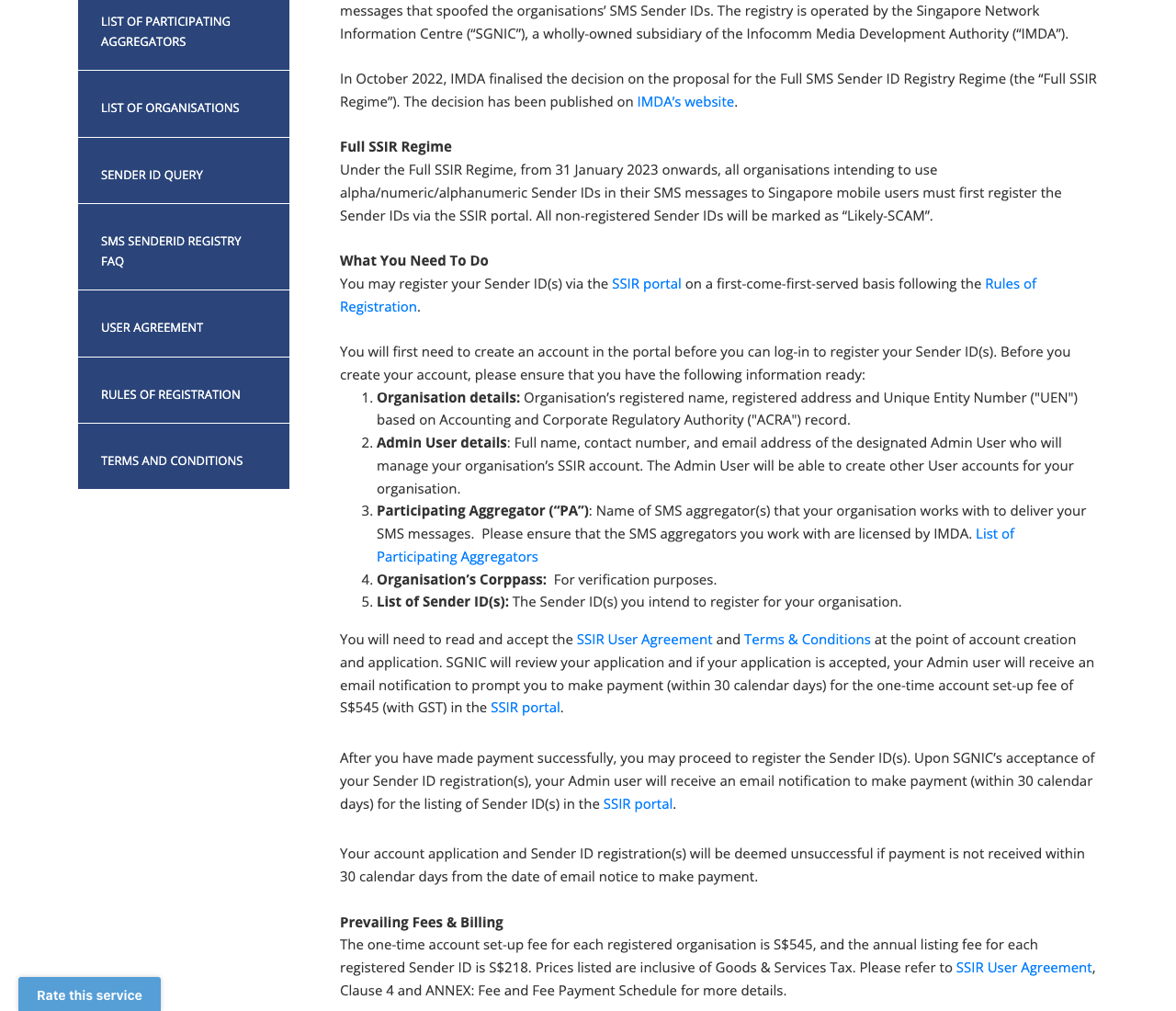
| Singapore | Yes, registered | SSIR (IMDA); needs a Singapore UEN; S$545 set-up plus S$218 a year per ID | 5 business days at Twilio, after SSIR | Yes · Yes | Shown as "Likely-SCAM" since 31 January 2023 | SGNIC, Twilio |
| UAE | Registered only | Required; promotional IDs carry an "AD-" prefix | 2 weeks (Twilio) | No · Yes | Blocked (Twilio); Vonage has international-brand registration on hold (30 July 2026) | Twilio, Vonage |
| Saudi Arabia | Registered only | Required; Twilio cannot register Saudi-based brands | 2 weeks (Twilio), 3–20 business days (Plivo) | No · No | Numeric senders filtered by carriers | Twilio |
| Turkey | Registered only | Required | 2 weeks (Twilio), 3–4 weeks (Plivo) | No · No | Blocked from 18 November 2026 (Twilio) | Twilio, Vonage |
| Indonesia | Registered only | Required; separate domestic and international processes | 4 weeks international, 3 weeks domestic (Twilio) | No · No | Blocked by Twilio on Telkomsel, Axiata and Smart since 21 September 2024 | Twilio |
| Philippines | Registered only | Required; no "TEST", "SMS" or network names in the ID | 2 weeks (Twilio), 7–15 business days (Plivo) | Yes · No | Blocked since 7 April 2025 (Twilio) | Twilio |
| Japan | Yes, dynamic (international route) | None internationally; Twilio's domestic gateway needs registration | Domestic route 5 weeks (Twilio) | Yes · Yes | International numeric senders get a 010 prefix on KDDI | Twilio |
| Nigeria | Yes | Twilio: required; Vonage: only for MTN | 3 weeks (Twilio), 10–12 business days (Plivo) | No · Yes | International numeric IDs fail on MTN, Airtel and 9mobile (Twilio) | Twilio, Vonage |
| South Africa | No (Twilio, AWS); MTN only, pre-registered (Vonage) | MTN only | Not documented | Yes · Yes | Replaced with a local number (Plivo) | Twilio table, Vonage |
| Colombia | No | Not applicable | Short code 4–10 weeks (Twilio) | Yes · No | Replaced by short codes such as 85307 or 87547 (Plivo) | Twilio |
| Argentina | No (guidelines page); "Yes" in Twilio's help table | Not supported | Short code 6–15 weeks (Twilio) | Yes · No | Random short code | Twilio |
| Chile | No | Not supported | Not documented | Yes · Yes | Random numeric sender (Twilio, Vonage, Plivo) | Twilio, Vonage |
Three patterns stand out. North America runs on registered numbers. South America mostly swaps your name for a short code or a random number whatever you send. Everywhere a regulator has built a registry (Australia, India, Ireland, Singapore, Spain), registration is no longer a deliverability tip: an unregistered name gets relabelled, replaced or blocked.
United States: phone numbers only
No provider we checked delivers alphanumeric sender IDs to US numbers. Telnyx's alphanumeric sender docs name the error (UnsupportedDestination for US, Canada and Puerto Rico) and let you set a fallback long code on the messaging profile. That leaves three senders, each with its own registration:
- 10DLC: a brand and a campaign registered through your provider with The Campaign Registry. Fees, review times and rejection reasons are in our A2P 10DLC registration guide.
- Toll-free: one verification request per number; toll-free texting verification covers the fields and review times.
- Short code: the slowest route. Twilio lists 6–10 weeks, a $1,000 setup fee and $3,000 a quarter for a random US short code (help center, updated 12 September 2025); AWS lists $650 setup, $995 a month and 12 weeks on its pricing page.
Canada also accepts only numbers. Vonage says traffic must come from a Canadian long number, a registered 10DLC, a Canadian short code or a verified toll-free number, and Twilio recommends short codes or verified toll-free numbers because Canadian carriers filter A2P messages strictly. Sending code for both countries is in how to send SMS with an API from Node.js and Python.
Brazil: short codes by default, brand names for local companies
In Brazil, A2P traffic runs on short codes, and a brand-name sender is possible only as a pre-registered alphanumeric ID on TIM, Claro and Vivo. Twilio's Brazil guidelines limit Brazilian long codes to person-to-person messaging; an international number works for A2P, but the sender "is not preserved".
Who can register a name is where providers split:
- Twilio marks pre-registration "Supported (Optional)", about 10 weeks, and asks for a customer-to-Twilio LOA; betting brands also need proof they appear on the federal government's list of permitted brands (help center, updated 21 July 2026). Its own alphanumeric support table, updated 25 August 2026, says "Registration Required" instead.
- Infobip says that "alphanumeric senders can only be registered by entities based in Brazil"; international traffic needs no registration and unregistered senders are "automatically converted into a short code" (LOA guidelines). Its format rules: brand name only, uppercase, no spaces or special characters, 11 characters at most. Twilio adds that Vivo accepts only uppercase IDs.
- Vonage, Plivo and AWS End User Messaging offer no alphanumeric sender for Brazil. Vonage names 28908 as an example of the short code your name becomes; Plivo says "Fixed short codes replace sender IDs"; AWS lists neither sender IDs nor long codes, only short codes. Bandwidth's page of 13 July 2026 agrees: "Local networks convert senders to short codes."
- Zenvia, a Brazilian provider, advertises a dedicated number or "o nome da sua marca" (your brand name) as sender on its SMS page; we found no sender documentation behind that claim.
A dedicated short code is the predictable route. Twilio lists 2–4 weeks, no setup fee and $715 a quarter ($2,620 a year) for a random short code; AWS lists $330 setup, $330 a month and about 4 weeks. Twilio's short code rules cap marketing at 7 messages per user per week. Sending hours are another split: Twilio prohibits marketing outside 09:00–22:00 and all day Sunday, while Bandwidth lists sending windows of 8am–8pm on weekdays and 8am–2pm on Saturdays, with nothing on Sundays.
Providers attribute these rules to the carriers or, in Infobip's case, to "local regulations" without naming one. The Anatel pages we read cover consent for operators' own advertising (Resolução 632/2014) and say nothing about A2P sender formats. Providers scored for Brazil are in the Brazil SMS rankings.
Mexico: register the name or get a short code
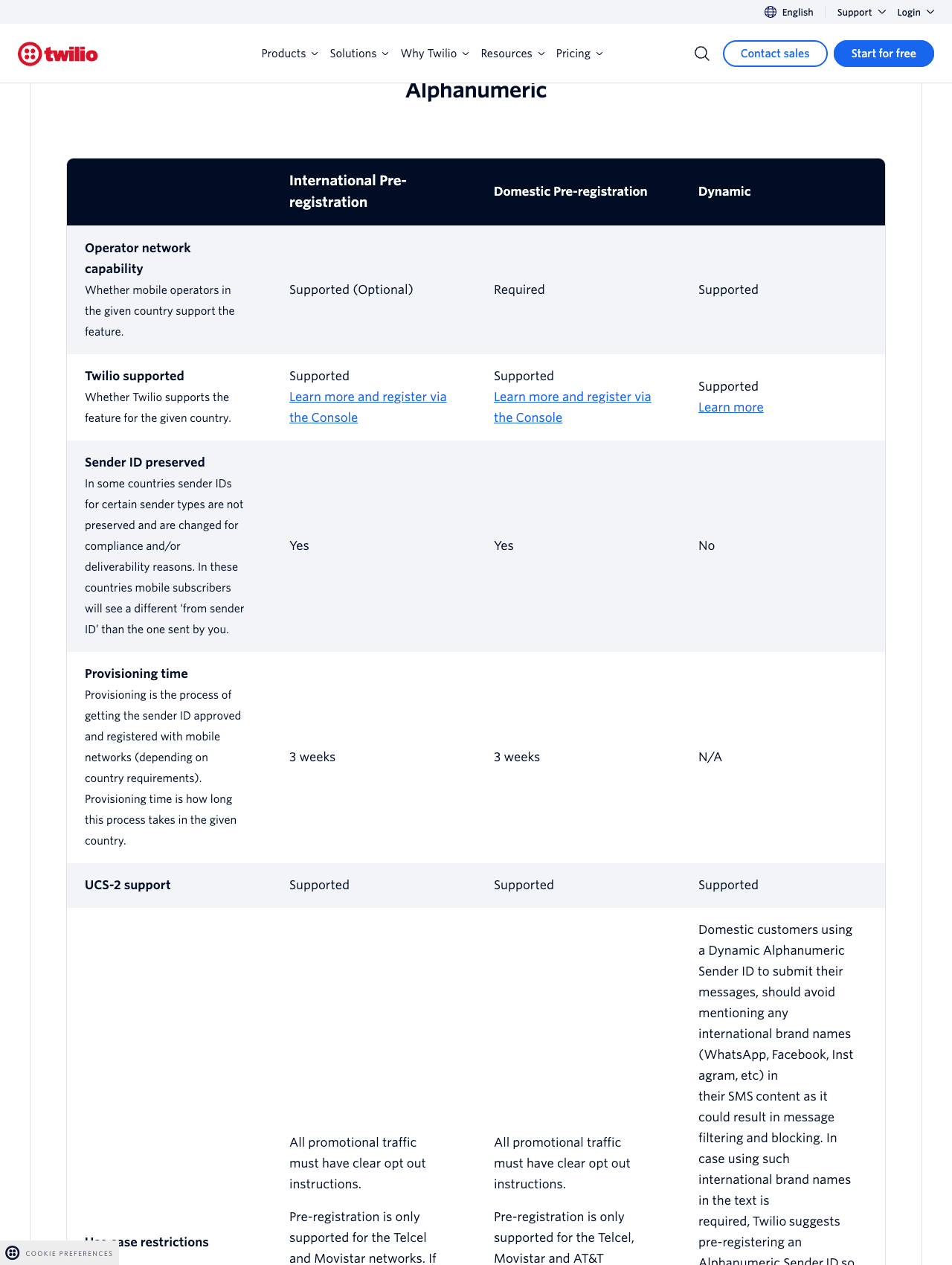
Mexico supports alphanumeric sender IDs, but only registered ones arrive as sent: Twilio's Mexico guidelines mark domestic pre-registration "Required", take about 3 weeks, and overwrite unregistered names with a short code or, sometimes, a random local number.
The details that trip up a first send:
- Registration covers only Telcel, Movistar and AT&T (international registrations Telcel and Movistar only). Traffic to other networks "will be delivered with a shared short code", per Twilio.
- Twilio's help table lists a minimum of 1,000 SMS a month for a registered ID. Financial and alcohol-related IDs need signed letters on Telcel and Telefónica templates (help center, updated 15 June 2026).
- Infobip's Mexico LOA page asks for a separate form per network, the Movistar one in Spanish, charges setup fees and says AT&T local registration needs "a local entity in Mexico".
- Mexican long codes are a poor fallback: Twilio says current regulations allow only OTP traffic from them, delivery is best-effort, and more than nine messages from one long code in two minutes triggers sender rotation. Twilio recommends a +1 number, a registered alphanumeric ID or a dedicated short code instead.
- A Mexican short code takes about 14 weeks at Twilio and costs $2,200 to set up plus $5,400 a quarter ($20,600 a year).
Not every provider reads Mexico this way. Telnyx's compliance guide lists pre-registration as "Not required", Plivo's coverage page says all sender IDs "are replaced with a random numeric sender, a short code, or a fixed sender ID", and the Sinch Engage table (updated 5 July 2026) marks alphanumeric as unsupported. Bandwidth adds a consent step: check REPEP, the do-not-contact registry run by consumer agency Profeco, before campaigns. Twilio advises Spanish-only content on registered domestic IDs. Compare providers for Mexico in the Mexico SMS rankings.
Where provider pages disagree
Most conflicts come from pages written at different times. The ones a developer is likely to hit:
- Brazil: optional (Twilio guidelines), required (Twilio help table), Brazil-based entities only (Infobip), not offered (Vonage, Plivo, AWS).
- Mexico: required (Twilio, Vonage, Infobip), not required (Telnyx), always replaced (Plivo), unsupported (Sinch Engage).
- United Kingdom: AWS says UK sender IDs "are required to be registered"; Twilio, Telnyx and Sinch Engage say registration is needed only for protected brand names or is merely recommended.
- France: Twilio's guidelines say pre-registration is "Not Required"; its help table and Telnyx's guide say registration is required.
- Italy: Twilio's guidelines accept dynamic IDs and AWS lists sender IDs as supported, while Vonage says international customers may not use them and Sinch Engage supports only aliases registered with AGCOM by brand owners based in Italy.
- Argentina: Twilio's help table says "Yes"; its guidelines page says local networks do not support dynamic IDs and deliver from a random short code.
- Stale tables behind regulator deadlines: Sinch Engage (5 July 2026) still marks Ireland and Spain "Registration not required", and Plivo's Australia page lists instant provisioning with no registration, although ComReg, CNMC and ACMA now enforce registries.
When a regulator publishes the rule (ACMA, CNMC, ComReg, IMDA, TRAI), follow the regulator. Otherwise follow the provider you will actually send through, since it controls the routes, and ask it which carriers the registration covers.
What happens to an unregistered sender ID
Three things, depending on the country: the name is replaced, labelled or blocked.
Replaced. AWS's sender ID docs say that where registration is required and your ID isn't registered, AWS "attempts to deliver the message with the Sender ID NOTICE" and it may not arrive; where sender IDs aren't supported, the message goes from a random long or short code. Telnyx says it "may use a generic alphanumeric sender ID to complete delivery". In Brazil, Mexico, Colombia, Argentina and Chile the replacement is a short code or random number, so recipients can't reply to the sender they see; Vonage's Mexico page asks senders to name a reply number in the message text instead.
Labelled. Singapore marks unregistered IDs "Likely-SCAM" (since 31 January 2023), Ireland "Likely Scam" (since 3 July 2025), Australia "Unverified" (since 1 July 2026, grouped into one thread on the handset). ComReg deferred its planned blocking stage in a 19 September 2025 update and, on 17 September 2026, counted 21,842 registered sender IDs.
Blocked. In the US, Twilio blocks 10DLC traffic without an approved campaign (error 30034) and has blocked unverified toll-free numbers since 31 January 2024 (help center). Twilio's country pages say carriers block unregistered IDs in the UAE and the Philippines (since 7 April 2025), and will in Turkey from 18 November 2026. In Spain, operators must block unregistered aliases from 15 September 2026, and CNMC's register page also tells providers to block messages that "relate to foreign companies not registered in Spain", unless the recipient is roaming.
Twilio's changelog added two error codes on 13 August 2025: 30041 for an ID that isn't registered or authorized, 30042 for one blocked as generic. Twilio says error codes "are subject to processing fees", so watch for them in status callbacks instead of retrying.
Before you send SMS abroad: a checklist
- List destinations and pick a sender per country from the table. The US and Canada need a registered number; in Brazil and the rest of South America a fixed sender means a short code, unless you are a Brazilian company registering its name.
- Decide whether you need replies. OTP codes and alerts can go one-way; support conversations need a long code or short code in a country where two-way works.
- Start registration first, code second. Lead times run from 5 business days (Australia, Singapore at Twilio) to 14–16 weeks (short codes in Mexico and Canada).
- Check entity requirements early. Singapore's registry needs a Singapore UEN (foreign firms go through a local subsidiary or branch, per the SGNIC FAQ); Brazilian alphanumeric registration needs a Brazil-based entity (Infobip); AT&T Mexico needs a local entity for local registration.
- Pick a sender name carriers accept: your brand, 11 characters or fewer, no generic words, no special characters beyond what the country allows (no dash in France since 1 March 2026, uppercase for Vivo in Brazil).
- Prepare documents: LOAs for Brazil and for financial or alcohol-related IDs in Mexico, trademark or company-register proof where the name differs from your legal name.
- Give alphanumeric recipients a way to opt out that doesn't depend on replying (a link or a keyword to a number).
- Log what was delivered. Store the status callback per message and alert on 30041/30042 at Twilio, on a NOTICE sender at AWS, or on Telnyx's fallback sender, so a silent replacement shows up before users complain.
Provider-by-provider scores for SMS, with published weights, are in our SMS API rankings; sign-in codes are ranked separately in the OTP rankings.
Related guides
- A2P 10DLC registration guide: brand and campaign registration, fees and review times for US long codes
- Toll-free texting verification: the US and Canada toll-free route, field by field
- Send SMS with an API from Node.js and Python: first message, status webhooks and retries
- SMS API rankings for the United States, Brazil and Mexico
- Provider cards: AWS End User Messaging, Plivo, Sinch, Telnyx, Twilio, Vonage, Zenvia
About this guide
The PingMyUsers editorial team wrote this article under the rules on the methodology page; the directory is operated by Sensaria AG in Switzerland. We did not create accounts, register sender IDs or send messages. Providers appear alphabetically unless a source is quoted; none paid for placement or reviewed the text. Twilio's pages appear most often because its country pages give the most fields per country among those we read (pre-registration, dynamic IDs, whether the ID is preserved, provisioning time), not because of any relationship. Regulatory summaries describe what regulators and providers publish and are not legal advice; check with counsel for your use case. Report an error to contact@sensaria.ch; corrections are dated and sourced.
Methodology
On 23 September 2026 we read, for each of the 24 countries: Twilio's SMS guidelines page (the alphanumeric, long code and short code tables) and its alphanumeric support table; Vonage's "SMS Features and Restrictions" article with its update date; Plivo's coverage page; the AWS supported-countries table and footnotes. We added Telnyx's compliance guide, Infobip's Brazil and Mexico LOA pages, Bandwidth's Brazil and Mexico pages, the Sinch Engage table and the pages of ACMA, CNMC, ComReg, IMDA/SGNIC, AGCOM, TRAI and Anatel. ACMA's site did not load from our location, so its two pages were read through Internet Archive copies dated 6 May and 2 September 2026. Sinch publishes per-country rules for its SMS API only inside its dashboard, so the Sinch Engage (business texting app) table stands in for Sinch. Short code prices come from Twilio's help center and AWS's pricing page. Where sources disagree, the table names both; we did not pick a winner without a regulator's page.
Last updated
23 September 2026: first version. Dates already announced will change rows: Turkey's block on unregistered IDs (18 November 2026) and ComReg's deferred blocking stage in Ireland. We re-check the table then and every six months.
Frequently asked questions
What is an SMS sender ID?
The name or number shown as the sender of a text message. It can be an alphanumeric name such as a brand, a long code (a normal phone number) or a short code; the US also uses registered 10DLC numbers, and the US and Canada toll-free numbers.
What is an alphanumeric sender ID?
A sender name of up to 11 characters, mostly letters and digits, such as a brand, used instead of a phone number. It is one-way: recipients cannot reply to it, so opt-outs need another route.
Which countries require sender ID registration?
Of the 24 countries checked on 23 September 2026, registries or mandatory registration apply in Australia, India, Indonesia, Ireland, Mexico (domestic traffic), Nigeria (per Twilio; MTN only per Vonage), the Philippines, Saudi Arabia, Singapore, Spain, Turkey and the UAE. Brazil registers names only for Brazil-based companies, according to Infobip; the UK only for protected brand names, according to Twilio (AWS says all UK sender IDs).
Can I use an alphanumeric sender ID in the US?
No. US and Canadian carriers accept only phone numbers: a registered 10DLC number, a verified toll-free number or a short code.
How long does sender ID registration take?
Provider estimates range from 5 business days (Australia and Singapore at Twilio) to 3 weeks in Mexico and 10 weeks for a Brazilian alphanumeric ID. Short codes: 2–4 weeks in Brazil, 6–12 weeks in the US and about 14 weeks in Mexico.
Does Brazil support alphanumeric sender IDs?
Only as pre-registered IDs on TIM, Claro and Vivo, and Infobip says only Brazil-based entities can register them. Vonage, Plivo and AWS offer no alphanumeric sender for Brazil; unregistered names arrive as a short code.
What happens if I send SMS with an unregistered sender ID?
Depending on the country, the name is replaced (short code, random number or a generic ID such as NOTICE), labelled ("Likely-SCAM" in Singapore, "Likely Scam" in Ireland, "Unverified" in Australia) or blocked (US, Spain, the Philippines, the UAE, Turkey from 18 November 2026).
Sources
- Twilio — United States: SMS Guidelines — checked 23 September 2026
- Twilio — Brazil: SMS Guidelines — checked 23 September 2026
- Twilio — Mexico: SMS Guidelines — checked 23 September 2026
- Twilio — SMS Guidelines by country (21 further country pages read: CA, GB, IE, DE, FR, ES, IT, IN, AU, SG, AE, SA, TR, ID, PH, JP, NG, ZA, CO, AR, CL) — checked 23 September 2026
- Twilio Help Center — International Support for Alphanumeric Sender ID (updated 25 August 2026) — checked 23 September 2026
- Twilio Help Center — Documents required to register your alphanumeric sender ID in Brazil (updated 21 July 2026) — checked 23 September 2026
- Twilio Help Center — Documents required to register your alphanumeric sender ID in Mexico (updated 15 June 2026) — checked 23 September 2026
- Twilio Help Center — How much does a Short Code cost? (updated 12 September 2025) — checked 23 September 2026
- Twilio Help Center — Brazil Short Code Best Practices (updated 16 September 2024) — checked 23 September 2026
- Twilio Docs — Error 30034: US A2P 10DLC, message from an unregistered number — checked 23 September 2026
- Twilio Help Center — Toll-Free Message Verification for US/Canada (updated 1 June 2026) — checked 23 September 2026
- Twilio Docs — Alphanumeric Sender IDs — checked 23 September 2026
- Twilio changelog — Updates to Alphanumeric Sender ID Compliance Checks and Error Codes (from 13 August 2025) — checked 23 September 2026
- AWS End User Messaging SMS — Supported countries and regions for SMS — checked 23 September 2026
- AWS End User Messaging SMS — Sender IDs — checked 23 September 2026
- AWS End User Messaging SMS — Choosing an origination identity — checked 23 September 2026
- AWS End User Messaging — Pricing (dedicated short codes by country) — checked 23 September 2026
- Vonage — United States SMS Features and Restrictions (updated 20 August 2026) — checked 23 September 2026
- Vonage — Canada SMS Features and Restrictions (updated 23 September 2025) — checked 23 September 2026
- Vonage — Brazil SMS Features and Restrictions (updated 17 July 2025) — checked 23 September 2026
- Vonage — Mexico SMS Features and Restrictions (updated 19 August 2025) — checked 23 September 2026
- Vonage — United Kingdom SMS Features and Restrictions (updated 17 July 2025) — checked 23 September 2026
- Vonage — Italy SMS Features and Restrictions (updated 17 July 2025) — checked 23 September 2026
- Vonage — Spain SMS Features and Restrictions (updated 10 September 2026) — checked 23 September 2026
- Vonage — India SMS Features and Restrictions (updated 6 March 2025) — checked 23 September 2026
- Vonage — Australia SMS Features and Restrictions (updated 11 August 2026) — checked 23 September 2026
- Vonage — UAE SMS Features and Restrictions (updated 30 July 2026) — checked 23 September 2026
- Vonage — Turkey SMS Features and Restrictions (updated 19 May 2026) — checked 23 September 2026
- Vonage — Nigeria SMS Features and Restrictions (updated 6 June 2025) — checked 23 September 2026
- Vonage — South Africa SMS Features and Restrictions (updated 23 July 2025) — checked 23 September 2026
- Vonage — Chile SMS Features and Restrictions (updated 17 July 2025) — checked 23 September 2026
- Plivo — SMS coverage: Brazil — checked 23 September 2026
- Plivo — SMS coverage: Mexico — checked 23 September 2026
- Plivo — SMS coverage by country (UK, AU, SA, TR, PH, NG, ZA, CO, CL, JP pages read) — checked 23 September 2026
- Telnyx — International SMS Compliance Guide — checked 23 September 2026
- Telnyx — Alphanumeric Sender ID — checked 23 September 2026
- Sinch Engage — Which countries support Alphanumeric sender IDs? (updated 5 July 2026) — checked 23 September 2026
- Infobip — Brazil Letter of Authorization (LOA) guidelines — checked 23 September 2026
- Infobip — Mexico Letter of Authorization (LOA) guidelines — checked 23 September 2026
- Bandwidth — Brazil Sender ID guidelines (13 July 2026) — checked 23 September 2026
- Bandwidth — Mexico Sender ID guidelines (13 July 2026) — checked 23 September 2026
- Zenvia — SMS product page (Brazil, Portuguese) — checked 23 September 2026
- ACMA — Sending text messages with your business or organisation name (last updated 4 December 2025; read via Internet Archive copy of 6 May 2026) — checked 23 September 2026
- ACMA — SMS Sender ID Register goes live (1 July 2026; read via Internet Archive copy of 2 September 2026) — checked 23 September 2026
- ComReg — SMS Sender ID Registry (figures of 17 September 2026) — checked 23 September 2026
- ComReg — ComReg urges organisations to register SMS Sender IDs now ("Registration is straightforward and free") — checked 23 September 2026
- SGNIC (IMDA) — SMS Sender ID Registry overview — checked 23 September 2026
- SGNIC (IMDA) — SMS Sender ID Registry FAQ (foreign companies and UEN) — checked 23 September 2026
- CNMC — Alias Register — checked 23 September 2026
- CNMC — Press release: register aliases before 15 September 2026 (1 September 2026, Spanish) — checked 23 September 2026
- AGCOM — Alias (alphanumeric sender identifiers, Delibera 12/23/CIR; Italian) — checked 23 September 2026
- TRAI — Advice to Senders/Telemarketers (TCCCPR 2018, DLT headers and templates) — checked 23 September 2026
- Anatel — Mensagens publicitárias (consumer rights page, modified 31 August 2025; Portuguese) — checked 23 September 2026