The best SendGrid alternative in 2026: 13 transactional email APIs ranked
Editorial team · updated · facts checked
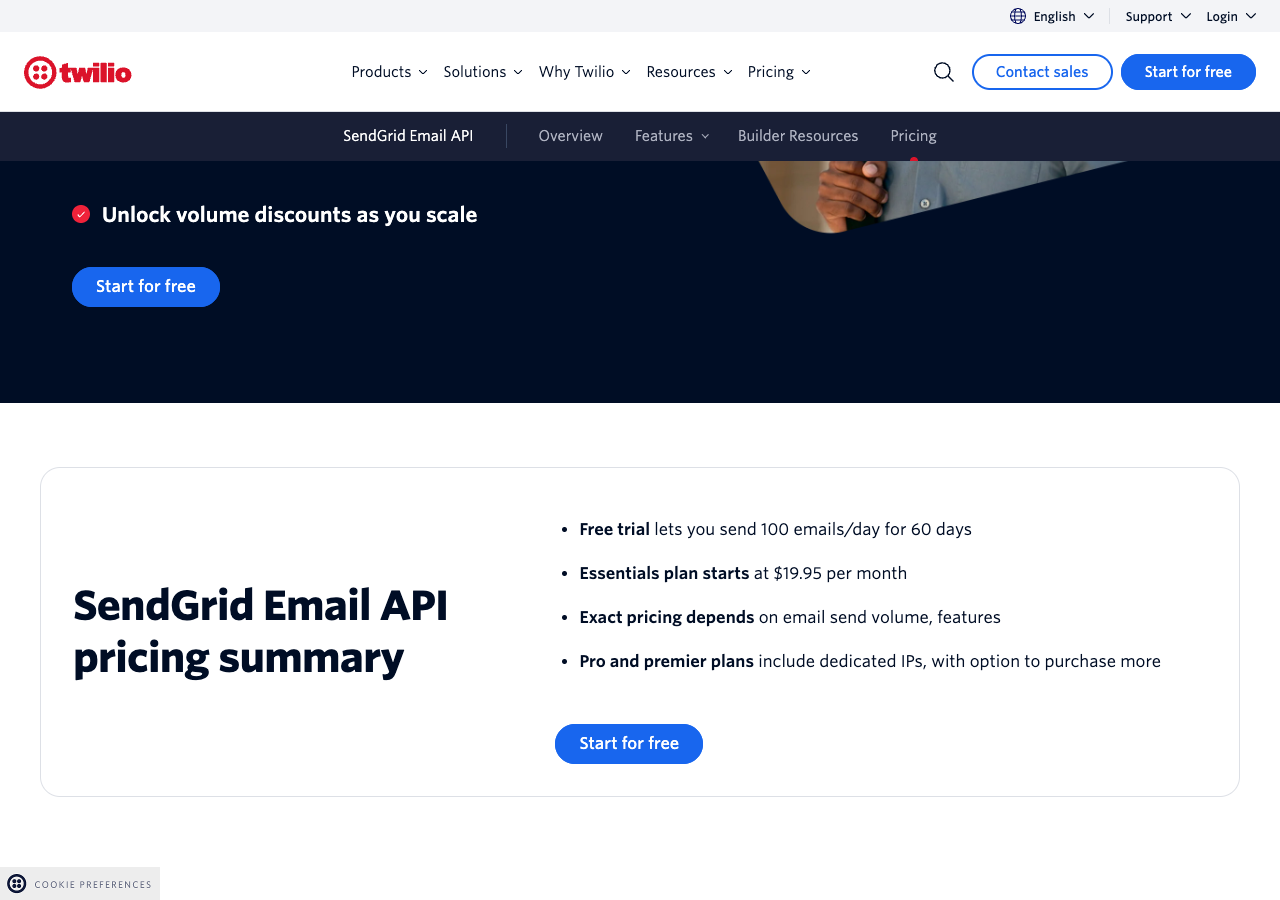
By our transactional email rating, out of 100, the five highest-rated email APIs are SendPulse (83.7), Brevo (80.0), Mailgun (78.6), Mailtrap (78.5) and Resend (78.0); Twilio SendGrid places 13th of 14. Nine of the 13 alternatives keep a free plan with no end date. New SendGrid accounts get a 60-day trial capped at 100 emails a day.
The list below covers every other transactional email provider in our dataset, ordered by the same score that drives the transactional email API rankings. The score weighs pricing and free tier (30%), developer and AI readiness (30%), reviews on Trustpilot, G2 and Capterra (25%) and email features (15%); the methodology page lists every criterion. Twilio SendGrid itself scores 56.4. SendPulse and Brevo are 3.7 points apart; where neighboring scores differ by a point or two, read the ranks as near-ties: a single new fact can swap them. Every score, rank and order on this page is read from the live ranking (methodology version 2026.09, preliminary), so it follows each card and weight change.
We built this page from our provider cards and re-read SendGrid's pricing page, trial article, authentication page and Mail Send reference on 24 September 2026. Nobody on the editorial team opened an account or sent an email, so nothing here describes delivery speed or inbox placement.
SendGrid alternatives compared
SendGrid first as the baseline, then the alternatives in rating order. Prices are monthly list prices in USD before tax, for the cheapest plan that covers the volume. Facts come from our provider cards, checked 23–24 September 2026.
| Provider | Rating | Free plan | 10,000 emails a month | 100,000 emails a month | Official MCP server | OAuth 2.0 | Signed webhooks | Idempotency key |
|---|---|---|---|---|---|---|---|---|
| SendGrid (baseline) | 56.4 | None: 60-day trial, 100 a day | $19.95 (Essentials 50K) | $34.95 (Essentials 100K) | Docs search only | No, API keys | Yes, no replay window | No |
| SendPulse | 83.7 | 12,000 a month; 400 a day, 50 an hour | $0 (free plan) | $74.85 (Pro)* | Yes, remote | Client credentials only | No | No |
| Brevo | 80.0 | 300 a day | $17 (Starter) | $82 (Starter) | Yes, remote; no transactional send | Private apps only | No | Yes, 30 minutes |
| Mailgun | 78.6 | 100 a day | $15 (Basic) | $75 (Foundation) | Yes, local | No | Yes, with replay check | No |
| Mailtrap | 78.5 | 4,000 a month; 150 a day | $15 (Basic) | $30 (Basic) | Yes, local | No | Yes, no replay window | No |
| Resend | 78.0 | 3,000 a month; 100 a day | $20 (Pro) | $35 (Pro) | Yes, remote and local | Yes | Yes, with replay check | Yes, 24 hours |
| Bird | 77.8 | 1,000 a month; 50 a day | $15 (Startup) | $30 (Startup) | Yes, remote and local | Yes | Yes, with replay check | Yes, about 3 hours |
| SMTP2GO | 76.7 | 1,000 a month; 200 a day | $15 (Starter) | $75 (Professional) | Yes, remote | No | No | No |
| Telnyx | 73.9 | None: $5 trial credit | $3 (pay as you go, beta) | $25 | Yes, remote and local | Yes | Yes, with replay check | Yes, 24 hours |
| Mailjet | 72.8 | 6,000 a month; 200 a day | $14.16 (Starter + overage) | $112 (Premium) | Read-only, local | No | No | No |
| Amazon SES | 66.7 | None: AWS credits | $1.00 (à la carte) | $10 | General AWS server | No, IAM credentials | Via Amazon SNS, no replay window | No |
| Infobip | 66.7 | None: 60-day trial | $8.70 (pay as you go) | $87 | Yes, remote | Client credentials only | Opt-in, no replay window | No |
| Postmark | 61.8 | 100 a month | $15 (Basic) | $115 (Basic 125K) | Yes, local | No | No | No |
| Zenvia | 40.9 | None | No USD price | No USD price | Third-party only | No | No | No |
* SendPulse shows prices in the visitor's currency. Its USD figures come from an Internet Archive capture of the US pricing page on 20 April 2026; the live page, loaded from Switzerland on 24 September 2026, showed euros. "Client credentials only" means the app gets a token for its own account and can't act for another user's account. "Replay check" means the vendor documents a signed timestamp or token you can use to reject old deliveries.
Why developers look for a SendGrid alternative
The free plan became a 60-day trial. Since 25 March 2025, new SendGrid accounts get a timed trial: up to 100 emails a day by API or SMTP, most Essentials features, no card. When the 60 days end, "email send via any web API or SMTP integration for the account will stop" unless you pick a paid plan, per SendGrid's trial article (updated 12 September 2026). Existing free accounts and accounts opened through partners such as Microsoft Azure stay on their current plan "unless otherwise notified"; cancelling one of those free plans moves it to "end of trial". AI search queries and forum thread addresses we logged for this page point to other cut-offs, such as 27 May 2025 and 27 July. A search of SendGrid's support center on 24 September 2026 found neither date; the trial article gives only 25 March 2025.
Mail Send has no idempotency key. The v3 Mail Send reference lists two header parameters, Authorization and Content-Encoding, and no de-duplication field in the body; batch_id only groups scheduled sends so you can pause or cancel them. If a request times out, your code can't tell whether SendGrid accepted it, so a retry can deliver the password reset twice. Bird, Brevo, Resend and Telnyx accept a key on their email send call. How the mechanism works is in our idempotency key explainer.
API keys only, and an MCP server that can't send. The v3 API authenticates with API keys sent as a Bearer token. OAuth 2.0 appears only as an option for securing the outbound Event Webhook, so an app can't ask a customer to connect their SendGrid account through a consent screen. SendGrid does offer scoped keys: a Custom Access key can be limited to mail.send. For AI coding tools, Twilio's MCP server searches Twilio and SendGrid docs and "does not execute API calls on your behalf"; it is a Public Beta, and execute-ready tools with OAuth are listed as planned, with no date. Sending from an agent goes through Twilio's SendGrid skills, which write code against your own key. Background on both: OAuth for AI agents and MCP and email MCP servers.
Review scores are split. SendGrid's company listing on Trustpilot averaged 1.2 of 5 from 611 reviews on 23 September 2026, against 4.2 on Capterra (754 reviews) and 4.0 on G2 (368). Its reputation component is the lowest of the 14 email providers we rate.
AI app builders skip it. Lovable's docs index names connectors for Brevo, Mailgun and Resend, not SendGrid (checked 23 September 2026). SendGrid still works from any server-side code; the gap is the one-click setup.
Price alone is a weaker reason than it looks. At 10,000 emails a month SendGrid's cheapest plan costs $19.95 against a peer median of $15.00, but at 100,000 its $34.95 is under the $74.85 median. Only Amazon SES, Telnyx, Mailtrap and Bird cost less at that volume.
The 13 alternatives, in rating order
Each block gives the rating and its coverage, the share of the rating's weight backed by verified facts. "Watch out" lists the weaknesses shown on the provider's card.
SendPulse
Rating 83.7, coverage 99 %. SendPulse has the largest free plan among the 14 providers: 12,000 emails a month, capped at 400 a day and 50 an hour, with no card. Moderators must approve the SMTP profile before the first send, which "usually takes up to 24 hours". Pro covers 100,000 emails for $74.85 a month (US capture, see the table note), and the same account sells SMS and WhatsApp. Its remote MCP server can send through the SMTP API, and MCP clients connect with an OAuth browser login; the REST API itself uses OAuth client credentials, a one-hour token for your own account. Reviews: 4.5 on Trustpilot (2,859), 4.6 on Capterra (773) and G2 (719).
Watch out: webhooks are not signed, API keys can't be scoped, there is no inbound email parsing and no idempotency key. Nothing is documented about what happens to email over the hourly or daily cap. SendPulse card
Brevo
Rating 80.0, coverage 99 %. Brevo's free plan allows 300 emails a day with no time limit, shared between campaigns and transactional mail, after Brevo approves the account; free-plan emails carry a "Sent with Brevo" sticker. Starter costs $17 for 10,000 emails and $82 for 100,000. Core hosting for every account is in the EU. Transactional sends accept an idempotency key kept for 30 minutes. OAuth uses the authorization-code flow, but Brevo's OAuth apps are private: only users in your own Brevo organization can authorize them. The official MCP server manages contacts, campaigns and templates and sends no transactional email; its token "grants full read/write access". Reviews: 4.0 on Trustpilot (7,219), 4.6 on Capterra (3,521).
Watch out: webhooks are not signed; Brevo offers IP allowlisting, credentials in the URL or a bearer token instead. Brevo card
Mailgun
Rating 78.6, coverage 98 %. Mailgun's free plan sends 100 emails a day with one custom domain and one day of logs. Basic costs $15 for 10,000; Foundation $75 for 100,000. Webhooks carry an HMAC-SHA256 signature over a timestamp and a random token, and Mailgun suggests caching the token to refuse replays. Domain Sending Keys can only send, for one domain. You choose a US or EU region, and message data stays there. The official MCP server runs locally and "does not expose any delete operations"; official plugins cover Claude Code, Cursor and Gemini CLI. Mailgun, like Mailjet, belongs to Sinch, and its 1,530 Trustpilot reviews average 4.1.
Watch out: API keys only, no OAuth; no idempotency key; email is the only channel. Mailgun card
Mailtrap
Rating 78.5, coverage 99 %. The free plan covers 4,000 emails a month, 150 a day, and sent and received mail share it; new accounts are also held to 150 an hour, and each domain passes an automatic compliance check. Basic costs $15 for 10,000 and $30 for 100,000, tied with Bird for the lowest subscription price at that volume. Tokens carry per-resource permissions down to one sending domain, the official MCP server and skills cover sending, templates and the testing sandbox, and webhooks are HMAC-signed. Reviews: 4.8 on G2 (77) and Capterra (36), 3.6 on Trustpilot (19).
Watch out: data is hosted only in the US (Mailtrap says EU storage is planned for 2026); the webhook signature has no timestamp, so replay checks are on you; no OAuth, no idempotency key; free logs last 3 days. Mailtrap card
Resend
Rating 78.0, coverage 100 %. The free plan allows 3,000 emails a month and 100 a day, counting received mail and every To, CC and BCC recipient. Pro costs $20 for 50,000 and $35 for 100,000. Resend documents OAuth 2.1 with PKCE, sending-only API keys that can be locked to one domain, an Idempotency-Key kept 24 hours (also as an SMTP header), Svix-signed webhooks and a hosted MCP server. Lovable has a Resend connector and Bolt's email walkthrough uses it.
Watch out: email only; all stored data sits in the US; a small review base, 31 reviews, with 2.5 on Trustpilot (21) and 4.8 on G2 (10). Resend card
Bird
Rating 77.8, coverage 98 %. Bird, formerly MessageBird, gives 1,000 free emails a month (50 a day, one domain). Startup costs $15 for 50,000 and $30 for 100,000. With Resend and Telnyx, it is one of three providers that answer yes in every developer column of the table: OAuth with authorization code and PKCE, an Idempotency-Key header kept about three hours, Standard Webhooks signatures with guidance to reject deliveries older than five minutes, keys scoped per product, and an MCP server that sends email, SMS and WhatsApp once the user signs in. Each organization is pinned to a US or EU region at sign-up.
Watch out: a small review base, 95 reviews across aggregators, with 1.6 on Trustpilot (22) and 3.9 on G2 (73). Bird card
SMTP2GO
Rating 76.7, coverage 99 %. Free covers 1,000 emails a month and 200 a day, throttled to 25 an hour until a sender domain is verified; SMTP2GO's Terms call free accounts "primarily for trial purposes". Starter costs $15 for 10,000; Professional $75 for 100,000 with a dedicated IP included. It has the highest reputation component of the 14 providers: 4.8 on Trustpilot (1,889), 4.9 on Capterra (178). Accounts live in a US, EU or Australian data center, API keys can be limited to named endpoints, and a remote MCP server can send if the key allows it.
Watch out: webhooks are not signed; no inbound email; no OAuth; no idempotency key. SMTP2GO card
Telnyx
Rating 73.9, coverage 97 %. Telnyx has no free plan, only a $5 trial credit. Its Email API is in beta at $0.30 per 1,000 up to 10,000 a month, so $3 at 10,000 and $25 at 100,000. It documents OAuth (authorization code and client credentials), Ed25519-signed webhooks with a five-minute window for email, an Idempotency-Key on email sends kept 24 hours, and remote and local MCP servers. SMS, WhatsApp and Verify sit in the same account.
Watch out: there is no SMTP relay, so tools that only take SMTP credentials, such as Supabase Auth, can't use it; plain API keys carry no permissions (OAuth clients do); the Email API and its rates are labeled beta. Telnyx card
Mailjet
Rating 72.8, coverage 98 %. Free sends 6,000 emails a month, 200 a day, with a Mailjet logo in the footer until the $19 Essential plan. Starter is $9 for 8,000, so 10,000 costs $14.16 with overage; 100,000 needs Premium at $112. Customer data stays in the EU, and 3,957 Trustpilot reviews average 4.0. The official MCP server is read-only: Mailjet says it "does not send emails".
Watch out: webhooks are not signed (Mailjet recommends basic auth in the URL); Email API keys have full access; no OAuth; no API to list or remove blocked recipients. Mailjet card
Amazon SES
Rating 66.7, coverage 98 %. SES has the lowest list price here: $0.10 per 1,000 emails à la carte, $1 at 10,000 and $10 at 100,000. New accounts start on the Essentials plan at $0.16 per 1,000 and can switch. There is no free quota, only AWS credits for new customers, and the SES FAQ still mentions 3,000 free message charges a month for 12 months, which the pricing page no longer lists. Until AWS grants production access, per Region, an account sends only to verified addresses, at most 200 messages per 24 hours. IAM policies can restrict ses:SendEmail by sender and recipient.
Watch out: no OAuth; events reach your endpoint through Amazon SNS rather than a webhook of its own; no idempotency key; the aws.amazon.com company listing on Trustpilot averages 1.3 (427). Amazon SES card · Amazon SES alternatives
Infobip
Rating 66.7, coverage 97 %. Infobip starts with a 60-day trial: up to 100 messages per channel, only to addresses verified at sign-up. Email is pay as you go at $0.87 per 1,000, so $8.70 at 10,000 and $87 at 100,000. API keys take scopes such as email:message:send, an expiry date and allowed IPs; the REST API's OAuth is client credentials only, while its per-product MCP servers support OAuth 2.1. Data is stored in the EU by default, and SMS, WhatsApp and 2FA share the account.
Watch out: no permanent free tier; webhook signing is opt-in and has no replay window; no idempotency key; email content is kept 2 days. Infobip card
Postmark
Rating 61.8, coverage 99 %. Postmark's free developer plan is 100 emails a month. Basic costs $15 for 10,000; the next tier that covers 100,000 is Basic 125K at $115. Transactional and broadcast mail run on separate message streams, content and activity are kept 45 days, and the official MCP server's 24 tools are marked read-only or destructive so a client can ask before a send.
Watch out: "Postmark does not currently support HMAC webhook signature verification"; there is no OAuth, server tokens have no sub-scopes, data stays in the US, and scheduled sending isn't available. Postmark card
Zenvia
Rating 40.9, coverage 84 %, against SendGrid's 56.4. Zenvia is a Brazilian platform that sells email in BRL and MXN packages alongside WhatsApp and SMS, from R$100 a month in Brazil. It has no USD price, no free tier, and only a third-party MCP server. It makes sense mainly for a team already using Zenvia for WhatsApp in Brazil or Mexico.
Watch out: webhooks are not signed, there is no OAuth and API tokens have no scopes. Zenvia card
Postmark vs SendGrid
| SendGrid | Postmark | |
|---|---|---|
| Rating | 56.4 | 61.8 |
| Free | 60-day trial, 100 a day | 100 a month, no end date |
| 10,000 emails a month | $19.95 | $15 |
| 100,000 emails a month | $34.95 | $115 (125,000 plan) |
| Webhook signature | ECDSA | None; basic auth and IP allowlist |
| Scheduled sending | Up to 72 hours ahead | Not available |
| Searchable activity | 3 days on Essentials (Email Logs 30 days) | 45 days |
| MCP server that sends | No | Yes, local |
Postmark wins on small volumes, message history and agent tooling; SendGrid wins on price at 100,000 emails, signed webhooks and scheduling. Neither offers OAuth or an idempotency key.
Brevo vs SendGrid
| SendGrid | Brevo | |
|---|---|---|
| Rating | 56.4 | 80.0 |
| Free | 60-day trial, 100 a day | 300 a day, no end date, "Sent with Brevo" sticker |
| 10,000 emails a month | $19.95 | $17 |
| 100,000 emails a month | $34.95 | $82 |
| Idempotency key | No | Yes, 30 minutes |
| Webhook signature | ECDSA | None |
| Data location | Global; EU on Pro and Premier | EU for every account |
| Other channels in the account | Marketing email | Marketing email, SMS, WhatsApp |
Brevo's free plan and the two providers' reviews account for most of the difference between their ratings. At 100,000 emails a month SendGrid costs less than half as much, and it signs its webhooks where Brevo doesn't.
Who should stay on SendGrid
- You still have a free account from before 25 March 2025. It stays on its plan unless SendGrid notifies you. Cancelling it moves you to "end of trial".
- You send 50,000 to 100,000 emails a month. Essentials 100K at $34.95 is among the five cheapest options at 100,000 in our data.
- You need EU data residency with dedicated IPs. Pro and Premier plans send through EU regional subusers with EU dedicated IPs.
- Your workflow runs on dynamic templates or Marketing Campaigns. Moving means rebuilding Handlebars templates, up to 300 per account.
- You want signed webhooks and scheduled sends. Six of the 13 alternatives (SendPulse, Brevo, SMTP2GO, Mailjet, Postmark, Zenvia) sign no webhooks, and SendGrid's API schedules up to 72 hours ahead.
How to choose a SendGrid alternative
- Will you run on a free plan past 60 days? Nine alternatives have one; compare the daily cap with your busiest day, not the monthly total. Our free email API tiers comparison shows what happens at each cap.
- Will an AI agent send or configure email? Pick a provider whose MCP server can send, and the narrowest key it offers. The AI readiness dataset lists MCP servers and skills for every provider.
- Do you retry failed sends? Only Bird, Brevo, Resend and Telnyx let the provider drop a duplicate for you.
- Does your app act for your customers' email accounts? You need OAuth with the authorization-code flow: Bird, Resend or Telnyx (Brevo only within your own organization).
- Where must data live? EU by default: Brevo, Mailjet, Infobip. Region choice or assignment: Mailgun, Bird, Amazon SES, SMTP2GO. US only: Postmark, Resend, Mailtrap.
- Do you only have an SMTP field to fill in? Every alternative except Telnyx and Zenvia documents an SMTP relay. Email API vs SMTP relay explains the trade-off.
Moving off SendGrid: what to carry over
- Domain authentication. Add the new provider's SPF and DKIM records next to SendGrid's and remove the old ones after cut-over; the transactional email guide covers the records and the Gmail and Yahoo sender rules.
- Suppressions. Export bounces, invalid emails, spam reports and unsubscribes before you leave, so the new provider doesn't mail people SendGrid was blocking. Telnyx documents CSV imports from SendGrid; Mailgun and Mailtrap take CSV imports too.
- Templates. SendGrid's dynamic templates use Handlebars; alternatives use their own syntax (Postmark uses Mustachio), so plan to rebuild rather than copy.
- Webhooks. Rewrite the Event Webhook handler: event names differ and so do signatures (HMAC at Mailgun, Resend and Bird, Ed25519 at Telnyx, none at several others). How signature checks and duplicate deliveries work is in our webhook explainer.
- Credentials. SendGrid's SMTP login is the literal username
apikeywith an API key as the password; every other provider uses its own. Keeping sending behind one function, as in our Next.js and React Email tutorial, makes the next switch a one-file change.
Providers not in our dataset
MailerSend, SparkPost, SendLayer, Maileroo, EmailLabs and AgentMail appeared in the searches ChatGPT and Gemini ran for this topic, and "Mailchimp Transactional vs SendGrid" has its own search demand. None is in our dataset yet, so this page gives them no score and makes no claim about them.
Related guides
- Best transactional email APIs, ranked: the live version of the scores above
- Free email API tiers compared: daily caps, card rules and what happens at the limit
- Email MCP servers: which providers let Claude Code or Cursor send
- OAuth for AI agents and MCP: delegated access vs API keys
- What is an idempotency key?: why a retried send can arrive twice
- Send email from Lovable and Supabase: custom SMTP for auth mail
- Vibe coding security checklist: keys, webhook signatures, MCP tokens
- Amazon SES alternatives: the same comparison with SES as the baseline
- Twilio alternatives: for SMS, WhatsApp and Verify, which Twilio sells in a separate account from SendGrid
- All provider cards, each fact with its source and check date
About this page
The PingMyUsers editorial team wrote this page under the rules on the methodology page; the directory is operated by Sensaria AG in Switzerland. Order follows the computed rating, not a commercial relationship, and no provider paid for placement or reviewed the text. We did not create accounts or send email. Report an error to contact@sensaria.ch; corrections are dated and sourced.
Methodology
The rating is the directory's category score for transactional email (methodology version 2026.09, preliminary): pricing and free tier 30, developer and AI readiness 30, reputation 25, email features 15. Since the changes of 24 September 2026, an official MCP server and agent skills weigh more inside developer and AI readiness, and a free email tier is graded by its size, from 0.4 of the free-tier points at 100 emails a month to full points at 10,000, with a trial or credits at 0.2. Unknown facts drop out and the remaining weights renormalize; coverage shows how much of the weight is backed by verified facts. Any OAuth 2.0 grant the API documents earns full OAuth credit, client credentials included (SendPulse, Infobip); Brevo's private-only OAuth and OAuth that exists only for an MCP server (Amazon SES) score half. Prices at 10,000 and 100,000 emails are the scoring scenarios: the cheapest public plan that covers the volume, overage included, in USD. Every fact above comes from a provider card field with a source and a check date (23 or 24 September 2026); on 24 September 2026 we re-read SendGrid's pricing page, its trial article through the support center's public API (and searched that API for other cut-off dates), its authentication page and the Mail Send reference, and captured the pricing screenshot. Review figures are aggregator snapshots from 23 and 24 September 2026. Section order follows 70 searches that ChatGPT and Gemini ran for five phrasings of this question.
Last updated
24 September 2026: first version. We re-check prices, plans and scores every six months, and sooner if SendGrid changes its trial or ships the MCP tools it lists as planned.
Frequently asked questions
What is the best SendGrid alternative?
By our transactional email rating, the three highest-rated email APIs are SendPulse (83.7), Brevo (80.0) and Mailgun (78.6). The best fit depends on volume, free-plan needs and whether an AI agent will send.
Is there a free SendGrid alternative?
Yes. Nine alternatives keep a free plan with no end date. Largest first: SendPulse (12,000 a month), Brevo (300 a day), Mailjet (6,000 a month), Mailtrap (4,000), Resend (3,000), Mailgun (100 a day), Bird (1,000), SMTP2GO (1,000) and Postmark (100).
Does SendGrid still have a free plan?
Not for new accounts. Since 25 March 2025 they get a 60-day trial at 100 emails a day, after which sending stops without a paid plan. Free accounts created earlier stay on their plan unless SendGrid notifies them.
Is Postmark better than SendGrid?
In our rating Postmark scores 61.8 and SendGrid 56.4. Postmark costs less at 10,000 emails ($15 vs $19.95), keeps 45 days of history and has an MCP server that sends. SendGrid costs far less at 100,000 ($34.95 vs $115) and signs its webhooks.
Is Brevo cheaper than SendGrid?
At 10,000 emails a month, yes: $17 vs $19.95. At 100,000, no: Brevo's Starter costs $82 against SendGrid's $34.95. Brevo also has a free plan of 300 emails a day.
Which SendGrid alternative works best with AI coding agents?
Bird and Resend document OAuth sign-in, idempotency keys, signed webhooks and hosted MCP servers that send. Telnyx has the same set but no SMTP relay. Mailgun, Mailtrap and Postmark run local MCP servers with API keys.
Who are SendGrid's main competitors?
In the searches ChatGPT and Gemini ran for this topic, the most-named were Postmark, Brevo, Resend, Mailgun and Amazon SES. Our dataset adds SendPulse, Mailtrap, Bird, SMTP2GO, Telnyx, Mailjet, Infobip and Zenvia.
Does SendGrid support idempotency keys?
No. The Mail Send API has no idempotency header or de-duplication field, checked 24 September 2026. A retried request after a timeout can send the email twice.
Sources
- Twilio SendGrid — Email API pricing (trial, Essentials from $19.95, FAQ "free SMTP plan") — checked 24 September 2026
- Twilio SendGrid — Overview of 60-Day Free Trial Plans for New SendGrid Accounts (updated 12 September 2026) — checked 24 September 2026
- Twilio SendGrid — Mail Send (v3 API reference) — checked 24 September 2026
- Twilio SendGrid — v3 API authentication — checked 24 September 2026
- Twilio SendGrid — API key permissions — checked 23 September 2026
- Twilio SendGrid — Event Webhook security features — checked 24 September 2026
- Twilio SendGrid — Send an email with dynamic templates — checked 23 September 2026
- Twilio SendGrid — Suppressions — checked 23 September 2026
- Twilio SendGrid — How to send an email with SMTP — checked 23 September 2026
- Twilio — Send emails in the EU with Twilio SendGrid — checked 23 September 2026
- Twilio — Twilio MCP server (Public Beta, read-only) — checked 24 September 2026
- Twilio — Twilio Skills for AI coding agents — checked 24 September 2026
- Lovable — docs index (email connectors) — checked 23 September 2026
- SendPulse — Transactional email pricing — checked 24 September 2026
- SendPulse — pricing page, Internet Archive capture of 20 April 2026 (US visitor, USD) — checked 24 September 2026
- SendPulse — SMTP limits — checked 24 September 2026
- SendPulse — Get started with SMTP (moderation) — checked 24 September 2026
- SendPulse — MCP server basics — checked 24 September 2026
- SendPulse — REST API (authorization) — checked 24 September 2026
- SendPulse — Enable webhooks for transactional emails — checked 23 September 2026
- Brevo — pricing — checked 24 September 2026
- Brevo — Transactional email product page — checked 24 September 2026
- Brevo — FAQs: What are the limits of the Free plan? — checked 23 September 2026
- Brevo — Idempotency for batch emails — checked 24 September 2026
- Brevo — OAuth 2.0 — checked 24 September 2026
- Brevo — Secure webhook calls — checked 24 September 2026
- Brevo — MCP server — checked 24 September 2026
- Mailgun — pricing — checked 24 September 2026
- Mailgun — Securing webhooks — checked 23 September 2026
- Mailgun — Authentication (Domain Sending Keys) — checked 23 September 2026
- Mailgun — MCP server — checked 24 September 2026
- Mailtrap — pricing (Markdown version) — checked 24 September 2026
- Mailtrap — Sending limits — checked 23 September 2026
- Mailtrap — Webhooks (signature verification) — checked 23 September 2026
- Mailtrap — MCP server — checked 24 September 2026
- Bird — Email API pricing — checked 24 September 2026
- Bird — Idempotency-Key header — checked 24 September 2026
- Bird — Webhooks and events — checked 24 September 2026
- Bird — Authentication for agents (auth.md) — checked 24 September 2026
- Bird — MCP server — checked 24 September 2026
- Resend — pricing (Markdown) — checked 24 September 2026
- Resend — Account quotas and limits — checked 24 September 2026
- Resend — Idempotency Keys — checked 24 September 2026
- Resend — Building an OAuth client — checked 24 September 2026
- Resend — Verify webhook requests — checked 23 September 2026
- Resend — MCP server — checked 24 September 2026
- SMTP2GO — pricing — checked 24 September 2026
- SMTP2GO — Free Plan (support article) — checked 24 September 2026
- SMTP2GO — Webhooks overview — checked 23 September 2026
- SMTP2GO — MCP — checked 24 September 2026
- Telnyx — Email API pricing (beta) — checked 24 September 2026
- Telnyx — Email API guide (sending, idempotency) — checked 24 September 2026
- Telnyx — Email webhooks and events — checked 23 September 2026
- Telnyx — Trial account privileges and limitations — checked 23 September 2026
- Telnyx — Remote MCP — checked 24 September 2026
- Mailjet — pricing — checked 24 September 2026
- Mailjet — Webhooks overview (Event API) — checked 23 September 2026
- Mailjet — Installing the Mailjet MCP Server — checked 24 September 2026
- Infobip — Email pricing — checked 24 September 2026
- Infobip — Free trial — checked 23 September 2026
- Infobip — API authorization (scopes) — checked 24 September 2026
- Infobip — MCP servers — checked 24 September 2026
- Amazon SES — pricing — checked 24 September 2026
- Amazon SES — FAQs — checked 24 September 2026
- Amazon SES — Request production access (sandbox limits) — checked 24 September 2026
- AWS — Setting up the AWS MCP Server — checked 24 September 2026
- Postmark — pricing — checked 24 September 2026
- Postmark — Webhooks overview — checked 24 September 2026
- Postmark — auth.md ("There is no OAuth") — checked 24 September 2026
- ActiveCampaign/postmark-mcp on GitHub (official Postmark MCP server) — checked 24 September 2026
- Zenvia — Planos e preços (Brazil, BRL) — checked 24 September 2026
- Zenvia — APIs v2 reference — checked 24 September 2026
- Trustpilot — sendgrid.com reviews (company listing) — checked 23 September 2026